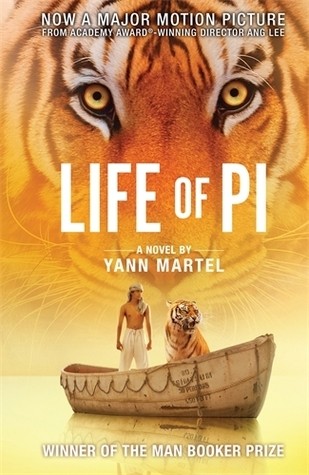
Life of Pi
by Yann Martel
If we, citizens, do not support our artists, then we sacrifice our imagination on the altar of crude reality and we end up believing in nothing and having worthless dreams.
Why read it
A cargo ship sinks in the Pacific. The survivors in the lifeboat: one sixteen-year-old boy, one zebra with a broken leg, one hyena, one orangutan, and one 450-pound Bengal tiger named Richard Parker. The arithmetic resolves quickly. The boy and the tiger have 227 days to go.
Pi Patel — raised in his father's zoo in Pondicherry, practicing Hinduism, Christianity, and Islam simultaneously because he just wants to love God — survives the wreck that kills his family and must keep a tiger alive, and himself off its menu, with a whistle, a manual, and zookeeper's psychology. Then, in a final chapter, Martel detonates the story: offered a version without animals, you must choose which account to believe. The novel is a machine for asking why we choose the stories we do.
Martel, broke after two books nobody read, traveled to India looking for a story and found the premise in a Brazilian novella's review (he credits it in the acknowledgments — controversy followed anyway). Published in 2001, it won the Booker Prize after nearly missing publication entirely, and sold 15 million copies on pure word of mouth: 'you have to get to the end.'
- 01
Zookeeping as survival
Territory, dominance, seasickness as a training tool — Pi keeps Richard Parker alive and deferential using real animal-behavior science, which is why the impossible premise feels procedural.
- 02
Three religions, one boy
The pre-wreck chapters — priest, imam, and pandit discovering each other's convert — are the book's comic heart and its thesis: Pi refuses to choose between stories of God.
- 03
The better story
The ending's question — offered two accounts of the same catastrophe, which do you prefer, and what does that say about faith? — is the most argued-about final chapter in modern fiction.
- 04
Richard Parker's exit
The tiger walks into the Mexican jungle without looking back, and Pi weeps not at the loss but at the lack of goodbye — the book's whole theory of meaning in one unceremonious moment.
The carnivorous island: an atoll of edible algae and meerkats that turns acid at night — paradise with digestion. Whether you read it as real, hallucinated, or allegorical determines which of the book's two stories you've already chosen.
Pi, starving, finally catches a fish and weeps as he kills it — 'a lifetime of peaceful vegetarianism stood between me and the willful beheading of a fish' — the moment the boy from the zoo becomes an animal himself.