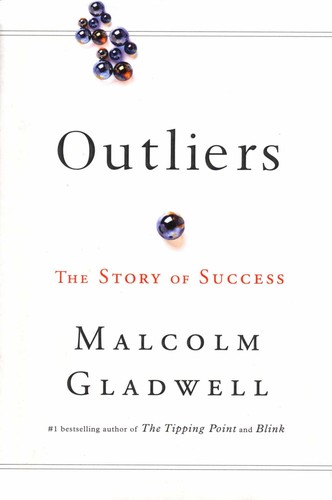
Outliers
No one — not rock stars, not professional athletes, not software billionaires — ever makes it alone.
Why read it
Why are elite Canadian hockey players born in January? Why did Korean Air crash planes until it changed the language spoken in its cockpits? Gladwell's most influential book dismantles the self-made myth: extraordinary success is talent plus hidden structures — birthdates, cultural legacies, and accidents of opportunity nobody puts in the acceptance speech.
We tell success as a story about individuals; Gladwell retells it as a story about ecosystems. The 10,000-hour figure everyone quotes is half his point — the other half is that nobody gets 10,000 hours without lucky access (a Michigan computer terminal in 1968, a Hamburg club demanding eight-hour Beatles sets). Where you're from, when you're born, and what your culture assumes about work and hierarchy do quiet, decisive work.
Gladwell, then the New Yorker's star essayist after The Tipping Point and Blink, published Outliers in 2008 — partly as autobiography in disguise: the final chapter traces his own Jamaican mother's improbable path through exactly the kinds of hidden doors the book catalogs. It spent two years on the bestseller list and injected 'relative age effect' and '10,000 hours' into common speech.
- 01
The Matthew Effect
Cutoff dates make the oldest kids in each cohort look 'gifted,' then compounding coaching makes it true — hockey's January birthdays are opportunity masquerading as talent.
- 02
10,000 hours — and access
Practice matters enormously and is unevenly available: Gates's terminal, Joy's Michigan mainframe, the Beatles' Hamburg residency — the hours require a door.
- 03
Legacy in the cockpit
The Korean Air chapters: high power-distance culture made first officers hint instead of warn — and retraining deference, not skill, fixed the crash rate.
- 04
Rice paddies and math
Cultures built on year-round meticulous agriculture produce persistence advantages measurable on math tests — effort norms as inheritance.
- 05
Demographic luck
Being born in 1955 (Gates, Jobs) or 1835 (Rockefeller-era industrialists) mattered as much as genius — timing as the invisible co-founder.
Christopher Langan, possibly America's highest IQ, ends up on a horse farm while Robert Oppenheimer — who tried to poison his tutor — charms his way to running the Manhattan Project: practical intelligence, taught by privileged families, as the difference.
The Beatles played roughly 1,200 live shows in Hamburg before their first hit — eight hours a night, seven nights a week — Gladwell's cleanest 10,000-hours case study.