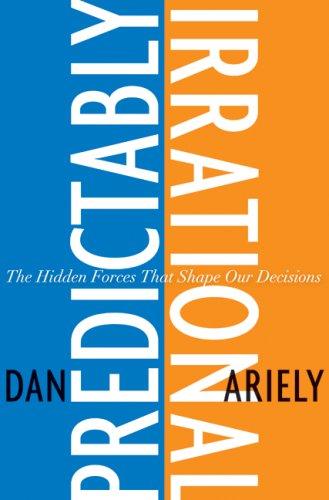
Predictably Irrational
by Dan Ariely
Our irrational behaviors are neither random nor senseless -- they are systematic and predictable.
Why read it
You believe you make careful, rational decisions about money, food, and love. A behavioral economist has run the experiments to prove that you do not, and the surprising part is that your mistakes are not random. They repeat, in the same shapes, for everyone.
Ariely shows through playful experiments how hidden forces, from the pull of 'free' to the trap of comparison to the placebo power of price, systematically distort our choices. Because these biases are consistent and predictable, we can learn to anticipate and guard against them. It is an entertaining, eye-opening tour of the flaws in human decision-making.
Dan Ariely, a professor at Duke, published Predictably Irrational in 2008, drawing on his own research in behavioral economics. It became an international bestseller and a foundational popular text in the field. Ariely's interest in how the mind copes with pain and choice grew partly out of his experience recovering from severe burns as a young man.
- 01
The power of FREE
The takeaway is that 'free' triggers irrational excitement, pushing us toward choices we would otherwise reject.
- 02
Everything is relative
We judge value by comparison, so a well-placed decoy can steer us without our noticing.
- 03
The cost of price
Expensive placebos work better than cheap ones, revealing how expectation reshapes experience.
- 04
Predictable, therefore fixable
Because biases are systematic, naming them is the first step to designing around them.
The Economist subscription experiment, where adding a pointless print-only option makes far more people choose the pricier bundle.
The Hershey's Kiss test, where dropping the price from one cent to free flips buyers' behavior entirely, the irrational lure of zero.