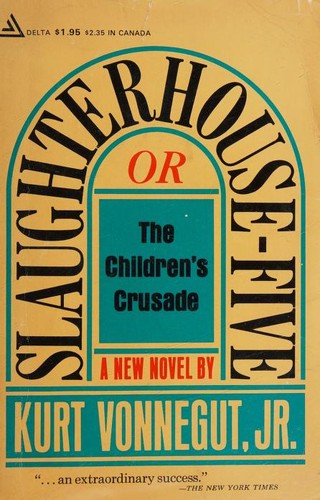
Slaughterhouse-Five
Everything was beautiful and nothing hurt.
Why read it
Billy Pilgrim, optometrist, has come unstuck in time — bouncing between his suburban marriage, an alien zoo, and the firebombing of Dresden, which he survived in a slaughterhouse meat locker as a prisoner of war. So did Vonnegut. It took him twenty-three years to find a shape for it; the shape was falling apart on purpose.
The Tralfamadorians — aliens who see all time at once — teach Billy that every moment is permanent, death is just a bad moment among fine ones, and free will is an Earthling delusion. Whether they're real or a broken veteran's coping machinery is the book's engine: Vonnegut wraps the century's worst night (135,000 dead in the official count he cites) in flying saucers and shrugs because direct telling was impossible — 'there is nothing intelligent to say about a massacre.' Every death in the book gets the same three words: so it goes.
Vonnegut was captured at the Battle of the Bulge and survived Dresden's firestorm in Schlachthof-fünf, then spent weeks excavating corpses from the rubble. The framing first chapter documents his two decades of failed drafts — and the war buddy's wife who made him promise not to glorify anything: 'You were just babies then.' He subtitled it The Children's Crusade and kept the promise. Published 1969, mid-Vietnam; it made him famous and remains constantly banned.
- 01
'So it goes'
The refrain after every death — over a hundred times — flattens champagne bubbles and massacres alike; the deadpan is the grief, wearing the only armor available.
- 02
Unstuck in time
PTSD given a science-fiction body: flashback as literal time travel. The structure lets Vonnegut put Dresden everywhere and nowhere, exactly as it lived in him.
- 03
The Tralfamadorian shrug
Fatalism as anesthesia — comforting, alien, and quietly damned by the book that presents it: acceptance of massacre is the disease wearing the costume of wisdom.
- 04
The author in the wreckage
Vonnegut appears in his own novel — 'That was I. That was me.' — collapsing the distance between fiction and testimony at exactly the moments it matters.
Billy watches a war film backward: bombers suck fire from a burning city, bombs fly up into racks, factories disassemble the metal into ore returned safely to the ground. The most quoted passage — an entire moral philosophy run in reverse.
After the firestorm, the surviving prisoners dig 'corpse mines' under Dresden — and old high-school teacher Edgar Derby is executed by firing squad for taking a teapot from the ruins. One teapot, one trial, one death the book treats as the war's clearest statement.