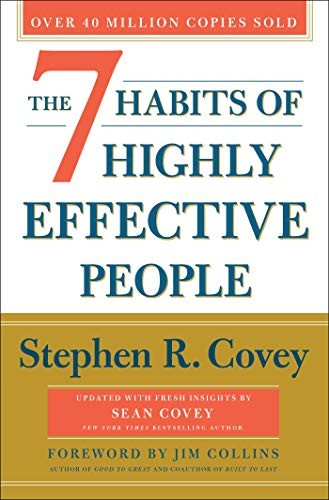
The 7 Habits of Highly Effective People
Between stimulus and response there is a space. In that space is our power to choose our response.
Why read it
Covey surveyed 200 years of American success literature and found a break: the first 150 years taught character; the last 50 taught personality tricks. His 1989 classic is the argument for going back — seven habits that run from private victory to public victory, which is why it outlasted every productivity fad that followed it.
Effectiveness is character expressed as habit, moving through three stages: dependence to independence (habits 1–3: proactivity, vision, priorities) to interdependence (habits 4–6: win-win, empathic listening, synergy), maintained by renewal (habit 7). The deep mechanism is the P/PC balance — production versus production capability — and the claim that lasting change works inside-out: private victories before public ones.
Covey, a Harvard MBA with a doctorate in religious education, built the book from his dissertation's survey of success literature and years teaching at Brigham Young. Published in 1989, it sold 40+ million copies, spawned a training empire, and put 'proactive,' 'win-win,' and 'sharpen the saw' permanently into management English.
- 01
The circle of influence
Proactive people work the circle they can affect and it grows; reactive people obsess over the circle of concern and it shrinks them — habit 1's diagnostic you'll apply weekly.
- 02
Begin with the end in mind
The imagined-funeral exercise and personal mission statement: define the destination before optimizing the speed.
- 03
Quadrant II
The urgent/important matrix — habit 3's insight that everything compounding (prevention, relationships, planning) lives in the important-but-not-urgent quadrant nobody schedules.
- 04
Seek first to understand
Habit 5's empathic listening — diagnose before you prescribe — remains the best single chapter on communication in the genre.
- 05
The emotional bank account
Trust as a balance built by deposits (courtesy, kept promises, loyalty to the absent) — the metaphor every relationship chapter since has borrowed.
The goose and the golden egg retold as management: kill the goose (people, assets, health) chasing eggs (output) and both die — Covey's P/PC balance applied to burned-out teams and neglected machines alike.
His own son's 'green and clean' lawn story: delegation by stewardship — agree on results, let the child judge himself — versus hovering supervision; corny, specific, and the model behind modern ownership culture.