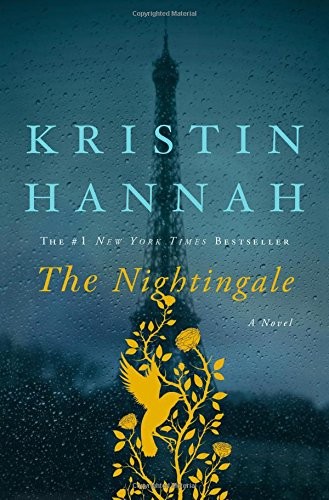
The Nightingale
If I have learned anything in this long life of mine, it is this: in love we find out who we want to be; in war we find out who we are.
Why read it
Two French sisters answer the German occupation in opposite tongues: Vianne, whose home is billeted by the enemy, learns the survival of small submissions — and Isabelle, nineteen and furious, walks downed Allied airmen over the Pyrenees under the code name the Gestapo comes to hate. Hannah's WWII novel sold four million copies by asking which courage is harder.
The war novel's usual spotlight — battlefields, men — is deliberately turned around: this is the occupation as women lived it, where heroism might be a forged ration card, a hidden Jewish child renamed as your son, or one more silent dinner beside a billeted officer. Framed by an elderly survivor in 1995 keeping her identity from the reader until the end, the book argues that history remembered the airmen's route but not the girl who walked it — 'in war, women's stories go untold.'
Hannah, a former lawyer with twenty novels behind her, found the seed in the true story of Andrée de Jongh, the 24-year-old Belgian who founded the Comet Line and personally escorted over a hundred airmen across the Pyrenees. Published 2015 after her son left for college — she calls it the book she'd been building toward — it spent years on the lists, sold 4.5 million copies, and reset her career at blockbuster scale.
- 01
Two kinds of courage
Isabelle's is legible — routes, codes, mountains; Vianne's is the kind history files under compliance until you count the children she saved. The book's engine is refusing to rank them.
- 02
The billet
An enemy officer at your table, then a worse one — Hannah uses Vianne's requisitioned house to study occupation at the scale it actually happened: one kitchen at a time.
- 03
The Nightingale's route
The Pyrenees crossings — espadrilles, safe houses, a teenage girl vouching for bomber crews twice her size — restore a real women's resistance network to the popular record.
- 04
The 1995 frame
An old woman packing for a reunion in Paris, name withheld — the ending's reveal recasts the whole book as an argument about which sister's story survived.
Vianne, forced to list the names of Jewish neighbors for her billeted officer, writes them in her own careful hand — and spends the rest of the book paying that page off, one hidden child at a time. Complicity and atonement sharing a single sheet of paper.
Isabelle's first crossing: an injured airman calling her 'just a girl' at the foot of the Pyrenees, and eighteen hours later, on the Spanish side, asking her name to tell his squadron. 'The Nightingale,' she says — the legend created between two footholds.