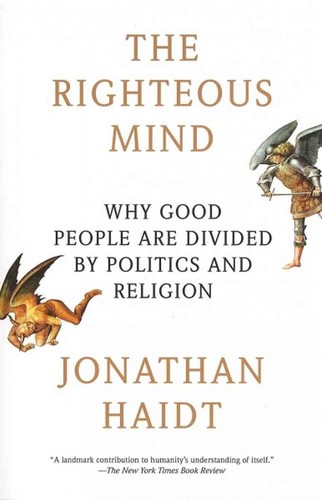
The Righteous Mind
Morality binds and blinds.
Why read it
Why can good, smart people who look at the same facts end up on opposite sides of politics and religion, each convinced the other is not just wrong but wicked? A social psychologist argues that the answer lies in how morality actually works, and it is not the way we think.
Haidt contends that moral judgment is driven first by fast, gut intuition, with reasoning arriving afterward to justify what we already feel, and that different groups build their morality on different foundations. Understanding those foundations, he argues, is the key to why we are so divided and how we might disagree more productively. It is a landmark synthesis of moral psychology.
Jonathan Haidt, a social psychologist, published The Righteous Mind in 2012, building on years of cross-cultural research and his Moral Foundations Theory. It became a bestseller and a widely cited touchstone in debates about polarization. Haidt wrote it explicitly to help left and right understand each other rather than merely to win an argument.
- 01
Intuitions come first
The core takeaway is that we feel our moral conclusions instantly and reason backward to defend them.
- 02
Six moral foundations
Care, fairness, loyalty, authority, sanctity, and liberty explain why groups weigh morality so differently.
- 03
The rider and the elephant
Reason is a small rider atop a large emotional elephant, useful for direction but not in control.
- 04
Groupishness
Morality binds people into teams and blinds them to other views, fueling both cooperation and conflict.
The 'moral dumbfounding' studies, where people are sure a harmless taboo act is wrong but cannot produce any reason why.
The rider-and-elephant metaphor, illustrated with research showing reasoning kicks in to rationalize a judgment already made.