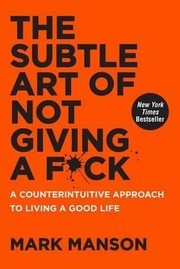
The Subtle Art of Not Giving a F*ck
by Mark Manson
Who you are is defined by what you're willing to struggle for.
Why read it
You have a limited number of f*cks to give, and you're spending them on strangers' opinions, minor inconveniences, and the fantasy that you're special. Manson's blog-post-turned-phenomenon — 15 million copies of profane Stoicism — argues that the good life isn't about caring less, but about caring accurately.
Positive thinking backfires: fixating on happiness advertises to yourself that you lack it. Manson's counter-program is choosing your problems — since life is suffering either way, meaning comes from selecting struggles worth having and values you can actually control. Being honest beats being impressive; responsibility isn't fault; and death, the final chapter's subject, is the only measuring stick that sizes your worries correctly.
Manson built a blunt-advice blog to millions of readers; the 2016 book distilled it, led by the viral essay 'The Most Important Question of Your Life' ('what pain do you want?'). It spent years atop bestseller lists mostly by word of mouth, launched the orange-cover wave of anti-self-help, and made 'choose your struggles' a phrase people say without knowing the source.
- 01
The feedback loop from hell
Anxiety about anxiety, anger about anger — Manson's opening diagnosis of modern self-consciousness, and why 'not giving a f*ck' about the meta-layer is step one.
- 02
Choose your suffering
Happiness comes from solving problems you enjoy having. The question isn't what you want — everyone wants the same things — but what pain you'll sign up for to get it.
- 03
You are not special
The entitlement critique cuts both ways: exceptional-victim and exceptional-genius are the same disease. Mediocrity accepted honestly is where growth actually starts.
- 04
Responsibility ≠ fault
The poker-hand principle: you didn't deal the cards, but you're playing them either way. The book's most quoted reframe, and its most useful.
Dave Mustaine gets fired from Metallica, forms Megadeth, sells 25 million records — and still measures himself a failure against the band that dropped him. Meanwhile Pete Best, ejected from the Beatles, reports a happier life than any of them. Metrics, not outcomes, decide your experience.
Hiroo Onoda spends 29 years fighting WWII in a Philippine jungle, refusing surrender leaflets as enemy tricks — devotion to a value that had stopped being real. Manson's cautionary portrait of caring wrongly, held to the end.