Dana Reyes★ Contributor · Lv 4
todayTerrifying in the most useful way. I bought blackout curtains by chapter six.
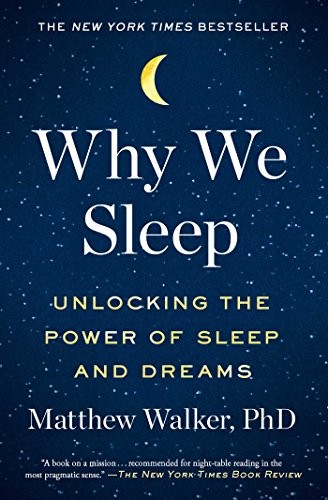
The shorter your sleep, the shorter your life span.
You already know you should sleep more. Walker's point is more alarming: chronic short sleep quietly wrecks your memory, immune system, mood, and lifespan, and the modern world has engineered an epidemic of it without most people noticing the damage.
Drawing on decades of sleep science, Walker argues that sleep is not a luxury but a biological non-negotiable, and that its two phases, NREM and REM, do distinct and vital work: consolidating memory, cleaning the brain, regulating emotion and hormones. Skimping on sleep, he contends, raises the risk of everything from Alzheimer's to cancer, and he makes the case for treating sleep as a public-health priority.
Published in 2017 by Matthew Walker, a professor of neuroscience and director of UC Berkeley's Center for Human Sleep Science. It became an international bestseller and pushed sleep into mainstream health conversation. It has also drawn scientific scrutiny over some of its stronger claims, a debate worth reading alongside the book itself.
Deep non-dreaming sleep consolidates facts while REM dreaming processes emotion and creativity; you need both.
Sleep lets the brain flush out metabolic waste, including proteins linked to Alzheimer's disease.
Both substances silently fragment and degrade sleep quality even when you feel you slept.
Losing sleep before learning can slash the brain's ability to form new memories.
Walker describes the 'spring-forward' daylight-saving experiment on millions of people, showing a measurable spike in heart attacks the Monday after we lose one hour of sleep.
He recounts studies where a single night's total sleep deprivation reduced the brain's memory-encoding capacity by around 40 percent.
Terrifying in the most useful way. I bought blackout curtains by chapter six.