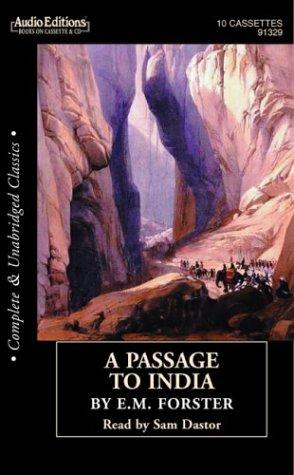
A Passage to India
by E.M. Forster
No, not yet. No, not there.
Why read it
In colonial India, a young Englishwoman visits the mysterious Marabar Caves with a kind Indian doctor eager to bridge two worlds, and emerges with an accusation that will ignite a town and put British rule itself on trial.
Set in the fictional city of Chandrapore under the British Raj, the novel follows Dr. Aziz's doomed friendship with the newly arrived Englishwoman Adela Quested and the schoolmaster Fielding. When Adela accuses Aziz of assaulting her in the caves, the ensuing trial exposes the impossibility of genuine connection across the chasm of colonial power, prejudice, and misunderstanding.
E.M. Forster drew on his own travels and work in India to write A Passage to India, published in 1924, his final novel. Widely regarded as his masterpiece, it was named one of the great English-language novels of the twentieth century and was adapted into an acclaimed 1984 film by David Lean.
- 01
The failed friendship
What awaits is the tender, fragile bond between Aziz and Fielding, tested to breaking by the machinery of empire.
- 02
The caves
The eerie, echoing Marabar Caves become the novel's void, where certainty and meaning collapse.
- 03
The trial
Adela's accusation turns a personal event into a public reckoning that lays bare colonial injustice.
- 04
Can they be friends
The book closes on whether English and Indian can truly connect, and the land itself seems to answer no, not yet.
The expedition to the Marabar Caves, where the disorienting echo overwhelms Adela and the alleged assault occurs offstage.
The courtroom scene in which Adela, under oath, falters and withdraws her accusation against Aziz.