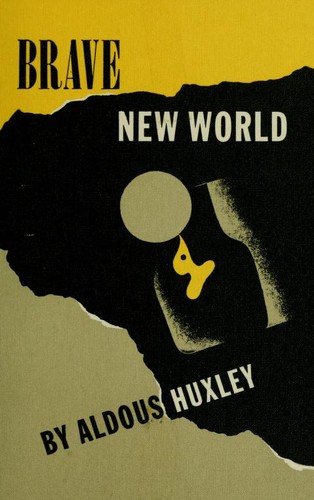
Brave New World
But I don't want comfort. I want God, I want poetry, I want real danger, I want freedom, I want goodness. I want sin.
Why read it
No secret police, no torture chambers, no banned books anyone misses. Huxley's dystopia controls its citizens with pleasure — engineered babies, guilt-free sex, a perfect drug — and asks the question 1984 doesn't: what if they don't have to force us at all?
In the World State, humans are decanted, not born — genetically caste-sorted from Alpha to Epsilon, conditioned to love their servitude, medicated with soma at the first flicker of discomfort. Stability has replaced truth, beauty, and God. Into this arrives John, a 'Savage' raised on a reservation with a volume of Shakespeare, who claims the right to be unhappy — and the novel becomes a debate between comfort and meaning that neither side wins.
Huxley wrote it in four months in 1931, initially as a parody of H.G. Wells's utopias, between the wars and amid Fordist mass production (the calendar runs 'After Ford'). Decades later he concluded in Brave New World Revisited that the future was arriving faster than he'd predicted — and, in a famous letter, told his former student George Orwell why pleasure would beat the boot.
- 01
Conditioning over coercion
Hypnopaedia, infant shock-training, sleep-taught class contempt — the State doesn't punish dissent; it manufactures citizens incapable of conceiving it.
- 02
Soma
'All the advantages of Christianity and alcohol; none of their defects.' The perfect drug is the book's sharpest invention — a society that has pharmacologically abolished grief, and with it depth.
- 03
Happiness vs. truth
World Controller Mustapha Mond knows exactly what was traded away — he keeps the banned Shakespeare in his safe — and argues, seriously, that it was worth it. Huxley gives the devil the best lines.
- 04
The right to be unhappy
John's climactic demand — poetry, danger, sin, God — is the book's thesis stated as a scream; the final chapters test what claiming it costs.
The opening tour of the Central London Hatchery — Bokanovsky twins budding by the dozen, embryos chemically stunted to fit their future jobs — remains the most chilling first chapter in dystopian fiction because everyone is so pleasant about it.
Helmholtz Watson, hearing Romeo and Juliet for the first time, bursts out laughing at the absurdity of mothers and star-crossed lovers — conditioning so complete that tragedy is unintelligible.