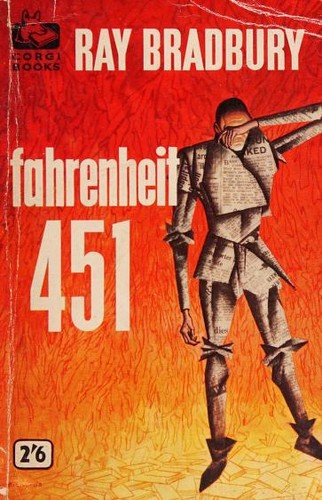
Fahrenheit 451
by Ray Bradbury
You don't have to burn books to destroy a culture. Just get people to stop reading them.
Why read it
Guy Montag is a fireman in a future where houses are fireproof and his job is burning books — until an odd seventeen-year-old neighbor asks him whether he's happy, and an old woman chooses to burn with her library rather than live without it. 451°F: the temperature at which paper ignites, and a conscience catches.
Bradbury's future banned books almost without government help: screens grew to wall size, sports and quiz shows filled the hours, offense-avoidance shaved literature down to digests, then to nothing. The firemen just formalize what the culture already chose. Montag's awakening — hoarding books he doesn't understand, seeking out a fired professor, turning his flamethrower around — is less a rebellion against the state than against his own anesthesia.
Bradbury wrote the first draft in nine days on a rented typewriter (10¢ per half hour) in the UCLA library basement, feeding dimes as fast as he could type — total cost $9.80. Published in 1953, in the shadow of McCarthyism and book burnings a decade cold, it became the rare censorship parable to be itself censored: his publisher quietly expurgated it for schools until Bradbury found out and raged it back into print.
- 01
The parlour walls
Mildred's wall-sized interactive 'family,' seashell earbuds murmuring all night — Bradbury's 1953 sketch of immersive media reads today like product documentation.
- 02
How the books died
Captain Beatty's history lesson — condensation, minorities' objections, the triumph of fun — is the book's core argument: censorship arrived by consensus, and the firemen came after.
- 03
Clarisse's questions
The girl who tastes rain and asks 'why' instead of 'how' lasts only a few chapters, and turns the whole novel — the case for curiosity as a subversive act.
- 04
The book people
Exiles by the railroad tracks, each having memorized a text until better times — Bradbury's ending proposes that literature's last-resort medium is human beings themselves.
The old woman strikes the match herself, quoting Latimer at the stake — and Montag, who has stolen one of her books almost involuntarily, can never again believe his work is only a job.
Montag tries to read Dover Beach to his wife's friends over the parlour noise; one weeps without knowing why, the others report him — poetry landing on nervous systems with no defense against it.