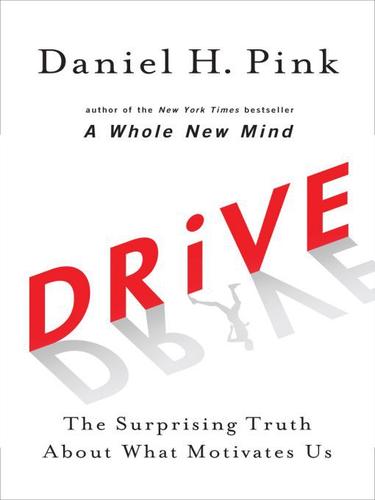
Drive
Control leads to compliance; autonomy leads to engagement.
Why read it
We assume people work harder when you dangle bigger rewards, yet decades of research show that carrots and sticks often backfire on the very tasks that matter most. What actually drives us turns out to be far more interesting than a bonus.
Pink synthesizes psychological research to argue that traditional reward-and-punishment motivation is outdated for creative, complex work. True, lasting motivation, he shows, comes from three intrinsic drives: autonomy, mastery, and purpose, the desire to direct our own lives, get better at things, and serve something larger.
Daniel H. Pink published Drive in 2009; it became a New York Times bestseller and one of the most influential business books of its era. It popularized decades of academic research on intrinsic motivation, including the work of Edward Deci and Richard Ryan, for a mainstream audience.
- 01
Motivation 3.0
You gain Pink's upgraded model of motivation, built for creative work where old carrot-and-stick methods fail.
- 02
Autonomy
The takeaway is that giving people control over their task, time, technique, and team unlocks engagement money can't buy.
- 03
Mastery
Pink shows that the drive to improve at something meaningful is a powerful, self-sustaining motivator.
- 04
Purpose
The final pillar is the human need to connect work to a cause larger than oneself, and why it now matters more than ever.
The candle problem experiments, in which offering a cash reward actually slowed people down on tasks requiring creative insight.
The example of companies granting autonomy time, from Australia's Atlassian FedEx Days to Google's 20 percent time, yielding breakthrough products.