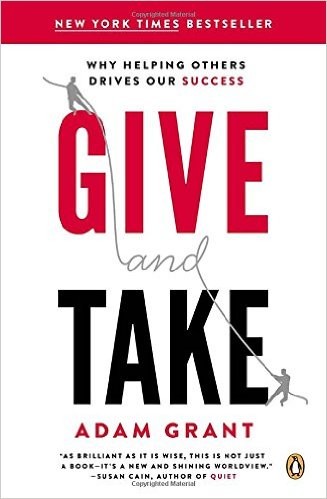
Give and Take
by Adam Grant
When givers win, people are rooting for them and supporting them, rather than gunning for them.
Why read it
We are taught that success goes to the sharp-elbowed and self-interested, the people who look out for number one. An organizational psychologist ran the data and found the opposite hiding in plain sight: the people at the very top are often the most generous in the room.
Grant sorts people into givers, takers, and matchers, and shows that while some givers finish last, the most successful people are also givers, the ones who help strategically without being exploited. He maps how generosity, done wisely, builds reputation, networks, and lasting achievement. It is a research-backed case that helping others is a smart long-term strategy, not just a virtue.
Adam Grant, the youngest tenured professor at Wharton at the time, published Give and Take in 2013 as his first book. It became a New York Times bestseller and helped launch him as a leading voice in organizational psychology. The book draws on his own research alongside studies across sales, medicine, and business.
- 01
Givers can win
The takeaway is that generosity, applied wisely, correlates with the greatest long-term success.
- 02
Otherish, not selfless
The best givers protect their own interests too, avoiding the burnout that sinks naive helpers.
- 03
Reputation compounds
Small, consistent favors build a network that quietly roots for you when it counts.
- 04
Redefining success
Givers measure winning by the impact they have on others, a durable and expandable definition.
Adam Rifkin, named Fortune's best networker, who built extraordinary influence through countless small 'five-minute favors.'
The contrast between the collaborative giver and the self-promoting taker, illustrated with figures like architect Frank Lloyd Wright, whose taking eventually cost him.