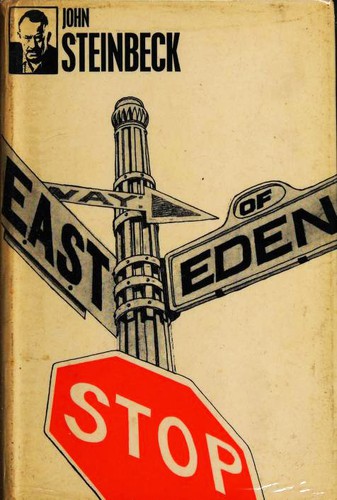
East of Eden
And now that you don't have to be perfect, you can be good.
Why read it
Two families, two generations, one California valley — and the oldest story in the world replayed until somebody finally reads it correctly. Steinbeck called everything before it 'practice' for this: a Cain-and-Abel epic with a monster for a mother and one Hebrew word carrying the whole point.
In the Salinas Valley (Steinbeck's own, narrated partly as family history), Adam Trask worships an unworthy wife and half-blinds himself to his sons; Cathy — one of fiction's purest sociopaths — shoots him and departs for a brothel; twins Cal and Aron replay Cain and Abel with the rejected-offering scene rebuilt as a business gift. Against determinism the book sets timshel — 'thou mayest' — the discovery by Adam's Chinese-American housekeeper Lee and his Bible-study elders that Genesis grants choice over sin, not commandment or predestination. Inheritance loads the gun; timshel is the finger that may decline.
Steinbeck wrote it in 1951 as a letter to his young sons, drafting each day's pages opposite journal entries to his editor (published as Journal of a Novel). His mother's family, the Hamiltons, appear under their real names; the timshel argument came from his own study of Hebrew with scholars. He told his editor: 'I think everything else I have written has been, in a sense, practice for this.'
- 01
Timshel
The book's engine: whether Genesis says sin 'shall' be mastered, 'must' be, or 'mayest' be. Lee's two-year investigation with Chinese elders is the novel's intellectual set piece — and its verdict on free will.
- 02
Cathy/Kate
Steinbeck's 'psychic monster' — introduced with the flat sentence that some people are born without conscience. Her chapters test the book's own thesis: can even she choose?
- 03
The rejected gift
Cal's $15,000, earned to redeem his father's failure and refused on moral grounds — the Cain story's sacrifice scene rebuilt so perfectly that the ancient rage arrives fresh.
- 04
Lee
The philosopher-housekeeper who performs pidgin for white customers who expect it and speaks Oxford English at home — the novel's wisest voice and its quiet essay on American masks.
Samuel Hamilton, Adam, and Lee name the twins over a Bible — and stumble into the seventeen verses of Cain and Abel, arguing translation until the whole novel's architecture stands exposed on a kitchen table.
The ending: Adam, stroke-ruined, blessing his guilty son with a single whispered word — timshel. The most argued-over final line in American fiction, and the book's entire philosophy delivered as a father's last act.