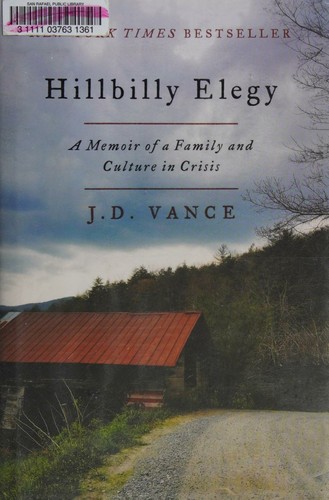
Hillbilly Elegy
by J.D. Vance
There is no group of Americans more pessimistic than working-class whites.
Why read it
A young man who clawed his way from a chaotic Appalachian childhood to Yale Law School looks back on the family, town, and culture that both broke and made him.
Vance offers a personal memoir of growing up amid poverty, addiction, and instability among the white working class of Appalachia and the Rust Belt. He interweaves his own story with reflections on the social decline, resentment, and lost mobility of a community he says was left behind.
Published in 2016, the memoir became a number one New York Times bestseller and was widely read as a lens on the year's political upheaval. It was adapted into a 2020 Netflix film directed by Ron Howard.
- 01
The pull of home
The takeaway is how deeply family culture and place shape a person's chances, for better and worse.
- 02
Instability's mark
Vance shows how a childhood of addiction and upheaval leaves lasting psychological scars.
- 03
Mamaw's saving grace
His tough, profane grandmother emerges as the anchor that made his escape possible.
- 04
A culture examined
The book argues that decline is driven by more than economics, sparking wide debate.
Vance's turbulent childhood with his addicted mother's revolving cast of partners and homes.
His grandmother Mamaw taking him in, whose fierce love and discipline steadied his path to college.