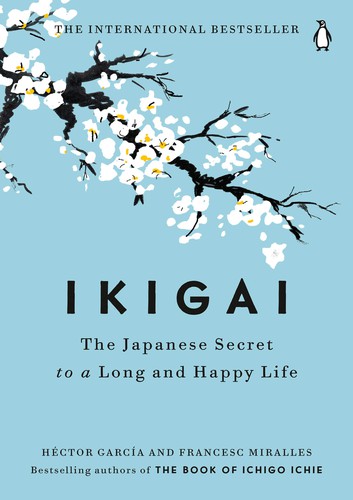
Ikigai
Only staying active will make you want to live a hundred years.
Why read it
Okinawa has the world's highest concentration of centenarians, and none of them ever 'retired' — there's no word for it in the local language. García and Miralles went to the village of the longest-lived people on earth and came back with a small book about the reason you get up in the morning. It has sold millions in a hurry-sick world.
Ikigai — roughly, 'the happiness of always being busy' with what matters to you — sits where what you love, what you're good at, what the world needs, and what pays can overlap. The authors braid interviews from Ogimi village with longevity science, Frankl's logotherapy, and flow psychology into a gentle protocol: move a little every day (radio taiso, gardening), eat to 80% full (hara hachi bu), keep your tribe close (moai — lifelong mutual-aid circles), stay lightly busy forever, and let purpose do the anti-aging.
García — a Spanish software engineer in Tokyo, author of the Geek in Japan blog — teamed with Barcelona writer Francesc Miralles after a conversation about why their Japanese friends seemed to age differently; they rented a house in Ogimi, interviewed a hundred elders, and wrote the book in Spanish. Published 2016, translated into 60+ languages — the spearhead of the Japanese-concept publishing wave (wabi-sabi, kaizen, shinrin-yoku) it largely created.
- 01
The moai
Okinawan mutual-aid circles — five friends committed for life, meeting to talk, pool money, and notice each other — the book's strongest evidence that longevity is a team sport.
- 02
Hara hachi bu
Stop eating at 80% full: the Confucian table rule Okinawans say before meals, matching the only intervention (caloric moderation) that reliably extends lifespan in research.
- 03
Flow as daily medicine
Csikszentmihalyi via the vegetable patch: the elders' 'busy' is absorbed, low-stakes work — the book argues micro-flow, not leisure, is what retirement gets wrong.
- 04
Never retire, retire the word
The Ogimi interviewees — 100-year-old weavers, 92-year-old farmers — treat purpose as non-transferable and non-expiring; the chapter that rearranges Western readers most.
The birthday party in Ogimi: a woman turning 100 dancing to live sanshin music, her moai around her — the authors' snapshot of what the statistics look like when they're having fun.
The interview refrain: asked their secret, elders answer with verbs — 'I make my vegetable garden,' 'I see my friends every day,' 'I weave' — never with abstractions. The book's whole thesis in their grammar.