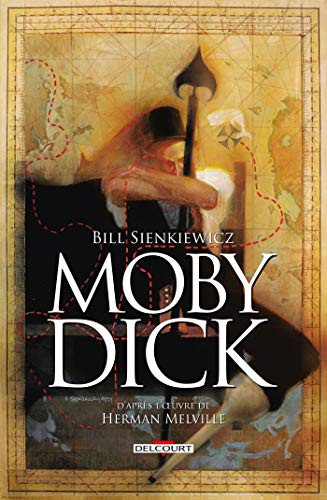
Moby-Dick
It is not down on any map; true places never are.
Why read it
Call me Ishmael: a depressed schoolteacher signs onto a whaling ship and discovers too late that its captain has repurposed the voyage — and every soul aboard — into a hunt for the white whale that took his leg. The great American novel about obsession, with an encyclopedia of whaling stapled to its hull.
Ahab's quarrel isn't with a whale; it's with the universe — the 'pasteboard mask' of visible things behind which either malice or nothing hides, and he means to strike through it. Melville braids the metaphysical hunt with total documentation of the whaling world (the cetology chapters readers skip and scholars treasure) because the book's method IS its meaning: humanity measuring, classifying, and boiling down the infinite, which then turns and stoves the boat. Ishmael survives to tell it; almost nothing else does.
Melville, a former whaleman himself, wrote it at 31 in a creative fever deepened by his friendship with Hawthorne, to whom it's dedicated — 'I have written a wicked book, and feel spotless as the lamb.' Published 1851, it baffled reviewers, sold about 3,000 copies in his lifetime, and was so forgotten that his 1891 obituaries misspelled the title. The 1920s revival installed it at the center of the canon, where it has annexed territory ever since.
- 01
Ahab's metaphysics
The quarter-deck speech — striking through the mask — is American literature's definitive statement of cosmic defiance; the crew signs on with a shout, and only Starbuck sees the blasphemy.
- 02
Ishmael's counter-method
Where Ahab narrows, Ishmael opens: digression, comedy, taxonomy, friendship. The novel's two survivors of meaninglessness — rage and curiosity — and only one floats.
- 03
The whiteness of the whale
The famous chapter arguing that white — absence, totality, blankness — is the true terror: Melville's essay on dread hiding inside a fish story.
- 04
Queequeg
The tattooed harpooneer whose coffin becomes Ishmael's life-buoy — the book's warmest creation, and its answer (friendship across every boundary) to the question Ahab answers with a harpoon.
Ahab nails a gold doubloon to the mast as prize for first sighting the white whale, then binds the crew with rum and crossed lances — a religious rite conducted by a captain who has replaced God with a grievance.
The Pequod meets the Rachel, whose captain begs help searching for his son, lost in boats after — Moby Dick. Ahab refuses without breaking stride. Days later it's the Rachel, still circling, that finds the one orphan of Ahab's own wreck: Ishmael.