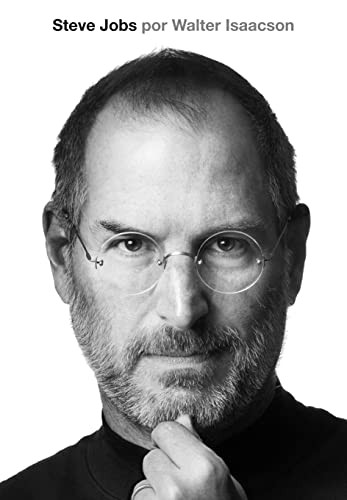
Steve Jobs
The people who are crazy enough to think they can change the world are the ones who do.
Why read it
Two years before his death, Steve Jobs handed his chosen biographer forty interviews and zero editorial control — then asked friends and enemies alike to speak freely. The result is the rare authorized biography with the subject's cruelty, tears, abandoned daughter, and reality-distortion field left in, alongside the products that changed six industries.
Isaacson's frame: Jobs stood at the intersection of humanities and technology, and his genius was editorial — saying no, simplifying, controlling the whole widget from silicon to store. The same traits ran both directions: the perfectionism that produced the Mac, Pixar, the iPhone also produced the brutal candor, the binary worldview (heroes and bozos), and the years-long grudges. The book refuses to resolve the contradiction, which is why it's the definitive portrait.
Jobs pursued Isaacson — biographer of Einstein and Franklin — for years; Isaacson agreed in 2009 when Jobs's cancer made the clock explicit. Forty-plus interviews with Jobs and a hundred-plus with family, rivals, and colleagues later, the book landed nineteen days after Jobs's death in October 2011 and became the best-selling book in the world that year.
- 01
The reality distortion field
Named by his own engineers: Jobs's ability to will impossible deadlines into fact by refusing to accept reality — productive and abusive in the same gesture.
- 02
The whole widget
End-to-end control — hardware, software, retail — against the open-licensing consensus; the strategy that nearly killed Apple in the 90s and then defined the iPhone era.
- 03
Simplicity as engineering
From the Zen gardens of Kyoto to one-button mice and the iPod's no-off-switch: Isaacson traces Jobs's aesthetic to Bauhaus, Buddhism, and his father's advice to finish the back of the fence.
- 04
The wilderness years
NeXT and Pixar as the education Apple never gave him — failure, patience (Pixar's decade to Toy Story), and the accidental acquisition that returned him home.
Jobs, fired from his own company at 30, sells all but one share of Apple stock and buys into a Lucasfilm graphics unit — Pixar — which Disney later acquires for $7.4 billion, making the ousted founder Disney's largest shareholder.
The iPhone's origin as defense: Jobs realizes phones with cameras will eat the iPod, cannibalizes his own best product, and forbids the word 'plastic screen' — the Corning gorilla-glass call is one of the book's best procurement stories.