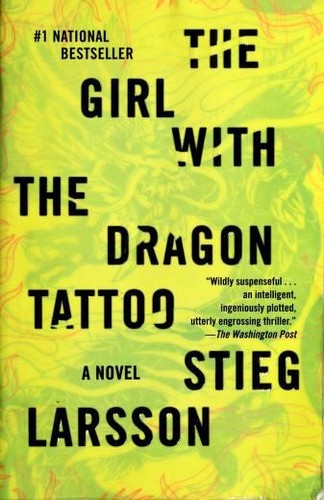
The Girl with the Dragon Tattoo
Friendship — my definition — is built on two things. Respect and trust.
Why read it
Forty years ago, a sixteen-year-old girl vanished from an island sealed off by a bridge accident — and every year since, her aging uncle receives a pressed flower from her killer. Now he hires a disgraced journalist to solve it, and the journalist gets a researcher: a pierced, antisocial hacker the state has spent her whole life failing.
Mikael Blomkvist, convicted of libeling a billionaire, takes a strange commission: solve Harriet Vanger's 1966 disappearance from inside her monstrous industrialist family. Lisbeth Salander — photographic memory, violent past, zero social graces, fiction's most influential hacker — becomes his partner. Larsson's real subject is stated in the Swedish title, 'Men Who Hate Women': institutional misogyny, from guardianship courts to boardrooms, and a heroine who refuses to be a victim on anyone's terms.
Larsson, a Swedish investigative journalist who spent his career exposing neo-Nazi movements (under real death threats), wrote the Millennium trilogy at night for fun and died of a heart attack at 50 — before the first book was published. He never saw it sell 100 million copies. At fifteen he witnessed a gang rape and never forgave his own inaction; the books are widely read as his atonement.
- 01
Lisbeth Salander
Ward of the state, judged incompetent by the system that abused her, lethal in her own defense — the character who reset expectations for heroines across every genre since.
- 02
A locked island, not a locked room
The Vanger island setup is golden-age detective structure (finite suspects, frozen evidence) executed with modern forensics and old photo archives — puzzle-solving at its most satisfying.
- 03
Journalism as method
Blomkvist solves crimes the way Larsson worked: source documents, financial records, patience. The book made slow, rigorous investigation feel thrilling.
- 04
The rot in respectable families
Nazis in the family tree, abuse behind industrial fortunes — Larsson's Sweden is a critique of the country's self-image, which is why Sweden read it most avidly of all.
Salander's revenge on her court-appointed guardian — meticulously documented, brutally proportionate, capped with a tattoo of her own — is the scene that made the character a phenomenon: justice from someone the justice system abandoned.
The pressed flowers arriving every year on Henrik Vanger's birthday — forty frames of the same taunt — is one of crime fiction's great openings: grief weaponized into a calendar.