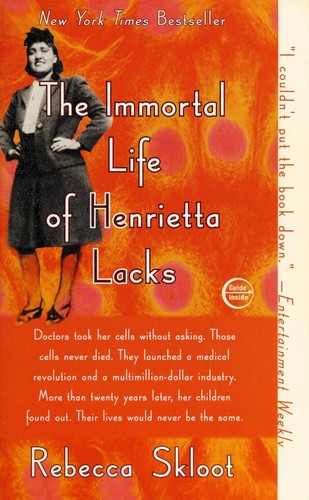
The Immortal Life of Henrietta Lacks
Like I'm always telling my brothers, if you gonna go into history, you can't do it with a hate attitude. You got to remember, times was different.
Why read it
In 1951, doctors at Johns Hopkins took cells from a dying Black tobacco farmer without her knowledge. Henrietta Lacks got a pauper's funeral; her cells never died — they became HeLa, the workhorse of modern biology, bought and sold by the trillion while her children couldn't afford health insurance. Skloot spent ten years getting the family's story told right.
Three braided strands: the science (HeLa cells enabling the polio vaccine, chemotherapy, IVF, gene mapping — 50 million metric tons of them grown to date); the history (Jim Crow medicine, 'benevolent deception,' Tuskegee's long shadow); and the family — especially daughter Deborah, whose quest to know her mother becomes the book's beating heart. Skloot's subject is consent and its absence: who owns tissue, who profits from it, and what science owes the bodies it builds on.
Skloot first heard 'HeLa' in a community-college biology class at sixteen, asked who the woman was, and got no answer — a question she then chased for a decade, funding reporting on credit cards and student loans while earning the deeply suspicious family's trust. Published 2010 after a decade of rejections predicted no audience: 75+ weeks at #1, translated into 25 languages, an Oprah/HBO film — and, in 2023, the Lacks family finally settled with a biotech firm that had profited from HeLa.
- 01
Immortal cells
Why HeLa mattered: the first human cells to survive and multiply indefinitely in culture — the lab infrastructure behind vaccines, cancer drugs, and space biology, explained with total clarity.
- 02
Consent's history
From 'benevolent deception' to modern IRBs — the book tracks how the rules changed, and how far they still don't reach (your discarded tissue, today, mostly isn't yours).
- 03
The family's arithmetic
Multibillion-dollar industries atop cells taken free from a woman whose descendants lack coverage — the injustice stated as ledger, not lecture.
- 04
Deborah
The daughter who wanted her mother's story more than money — her breakdowns, faith, and fierce partnership with Skloot make the book a double portrait: Henrietta, and the cost of retrieving her.
Deborah holding a vial of her mother's living cells at Hopkins for the first time — warming it in her hands, whispering to it — the book's emotional summit: biology and grief occupying the same test tube.
The 1980s revelation that scientists had drawn blood from the Lacks children for years — the family believing they were being tested for cancer, the researchers mapping HeLa contamination — consent's absence repeating a generation later.