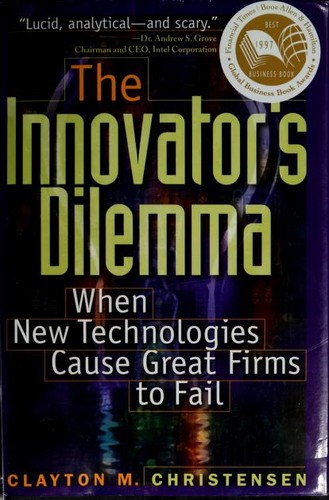
The Innovator's Dilemma
The reason [for failure] is that good management itself was the root cause.
Why read it
Why do brilliantly run, market-leading companies, the ones doing everything textbooks say is right, get blindsided and destroyed by upstarts with inferior products? Christensen's unsettling answer: they fail precisely because they listen to their best customers and manage well.
Christensen distinguishes 'sustaining' innovations, which improve products for existing customers, from 'disruptive' ones, which start out worse and cheaper but improve fast and eventually take over. Established firms rationally ignore disruptions because they serve unattractive, low-margin markets, until it is too late. The dilemma is that the very practices that make a company successful are what make it vulnerable.
Published in 1997 by Harvard Business School professor Clayton Christensen, based on his detailed study of the hard-disk-drive industry and others like steel and excavators. It became one of the most influential business books ever written, coined the modern sense of 'disruptive innovation,' and was famously cited by leaders from Steve Jobs to Andy Grove.
- 01
Sustaining vs. disruptive
The key distinction: disruptions start inferior and cheap, then climb upmarket until they displace the leaders.
- 02
Listening to customers can kill you
Good firms ignore disruption because their best customers do not yet want it, a fatal rationality.
- 03
Value networks
Companies are trapped by the cost structures and customers of the market they were built to serve.
- 04
The spin-out solution
Christensen argues incumbents must launch disruptions in separate, independent units to survive them.
The detailed history of the disk-drive industry shows successive leaders wiped out at each shift to smaller drives, despite superb management, a near-experimental proof of the theory.
The case of mechanical-excavator makers overtaken by hydraulic 'inferior' machines shows the same pattern repeating in heavy industry.