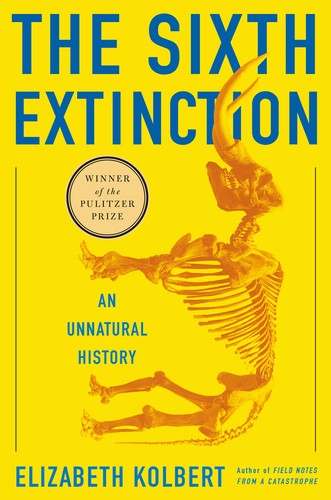
The Sixth Extinction
If you want to think about why humans are so dangerous to other species, you can picture yourself, holding a book on your lap.
Why read it
Life on Earth has been nearly wiped out five times before, and a science journalist sets out across rainforests, reefs, and museum drawers to document the sixth great extinction, the one happening now, caused by us.
Elizabeth Kolbert combines field reporting and history of science to show how human activity, from carbon emissions to species transport, is driving die-offs on a geological scale. Each chapter follows a single species or scientist to make an abstract catastrophe concrete. It is a clear-eyed, deeply reported account of humanity as a planetary force.
Elizabeth Kolbert, a New Yorker staff writer, published The Sixth Extinction in 2014, and it won the 2015 Pulitzer Prize for General Nonfiction. It became a widely cited touchstone in popular understanding of biodiversity loss and the Anthropocene.
- 01
Extinction has a history
The very idea that species die out was once radical, and the book traces how we learned it.
- 02
One species per chapter
Abstract catastrophe becomes tangible through a single frog, auk, or ammonite.
- 03
Humans as a geologic force
The takeaway is that we are now an agent on the scale of asteroids and ice ages.
- 04
Oceans in trouble
Acidification, driven by our carbon, threatens the base of marine life.
The Panamanian golden frog, vanishing as the chytrid fungus, spread by human travel, wipes amphibians off entire mountainsides.
The story of the great auk, a flightless seabird hunted to extinction, as a case study in how humans erase a species directly.