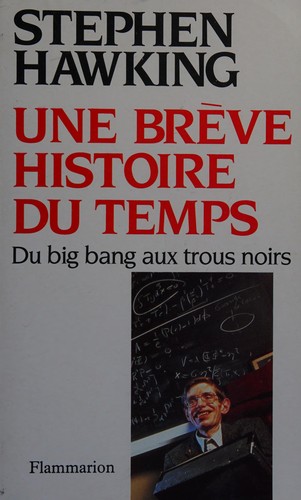
A Brief History of Time
However difficult life may seem, there is always something you can do and succeed at.
Why read it
Where did the universe come from, does time have a beginning, and what happens at the edge of a black hole? A physicist who could no longer move or speak set out to answer the biggest questions in plain English — with a single equation, E=mc², because his editor warned every additional one would halve the sales. It sold 25 million copies.
Hawking walks the general reader from Aristotle to the edge of a unified theory: the expanding universe, the Big Bang, black holes and the radiation that bears his name, the arrows of time, and whether a 'theory of everything' would leave anything for a creator to do. The book's wager is that the deepest physics can be carried by images — balloons, spinning tops, a cosmic horizon — without lying, and it largely wins the bet.
Diagnosed with ALS at 21 and given two years, Hawking wrote the book in his forties — partly to fund his children's education and his nursing care — dictating through the early stages of losing his voice entirely; by publication in 1988 he spoke through the computer that became his trademark. It stayed on the Sunday Times bestseller list a record 237 weeks, becoming the most famous 'unread' book in the world — a joke Hawking told better than his critics.
- 01
The universe has a history
From Hubble's redshifts to the cosmic microwave background — you'll follow the actual evidence trail that turned 'eternal universe' into 'Big Bang' within one scientist's lifetime.
- 02
Black holes aren't black
Hawking radiation — his signature result, explained with virtual particle pairs at the event horizon — means black holes glow, shrink, and eventually die. Quantum theory and gravity, arguing in public.
- 03
The arrows of time
Why do we remember the past and not the future? Hawking ties thermodynamic, psychological, and cosmological time together in the book's most mind-bending chapter.
- 04
The no-boundary universe
His proposal with Jim Hartle: time behaving like a direction on a sphere, a universe with no edge and no beginning to point at — and the famous closing question about what room that leaves 'for a creator.'
The opening anecdote: an old woman interrupts a cosmology lecture to insist the world rests on a giant tortoise — 'and it's turtles all the way down!' Hawking's point: every cosmology, including ours, must answer her.
The final line — understanding why the universe exists would let us 'know the mind of God' — became the most quoted sentence in science publishing, by an author the book reveals as anything but devout.