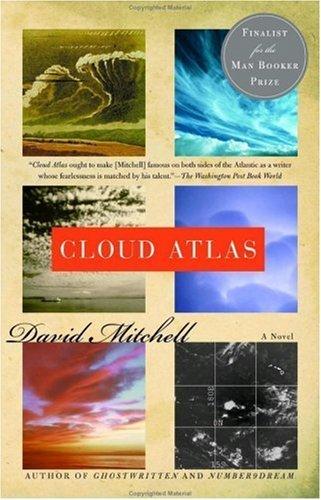
Cloud Atlas
Our lives are not our own. From womb to tomb, we are bound to others, past and present, and by each crime and every kindness we birth our future.
Why read it
A nineteenth-century sea voyage, a 1930s composer's letters, a 1970s conspiracy thriller, a far-future dystopia, and more: six nested stories that seem unrelated until you notice each is being read, or watched, inside the next.
Mitchell's virtuosic novel is a Russian doll of six interlocking narratives spanning centuries and genres, bound by the theme that individual acts of cruelty and kindness ripple across time. It asks whether humanity is doomed to prey on itself, and whether small moral choices can still matter against that tide.
David Mitchell published Cloud Atlas in 2004; it was shortlisted for the Booker Prize and won the British Book Awards Literary Fiction Award. Its intricate structure was long called unfilmable until the Wachowskis and Tom Tykwer adapted it into a 2012 feature film.
- 01
The nested structure
You experience a book built like a matryoshka doll, each story interrupted and later resumed, so form becomes meaning.
- 02
Predator and prey
Across every era, the strong consume the weak, and what awaits is Mitchell's grim, insistent question of whether that can change.
- 03
Souls across time
A recurring comet-shaped birthmark hints at reincarnation, linking characters into a single moral chain.
- 04
Genre as costume
Each section masters a different style, from sea diary to thriller to dystopia, showing storytelling itself as a survival tool.
Sonmi-451's testimony in a future Korea, where a cloned fast-food server awakens to consciousness and rebellion before her execution.
Zachry's post-apocalyptic Hawaiian narrative at the book's center, the one story told in full before the structure folds back outward.