Miles Ovadia★ Curator · Lv 5
todayThe scale is staggering. The first sci-fi in years that made me feel genuinely small.
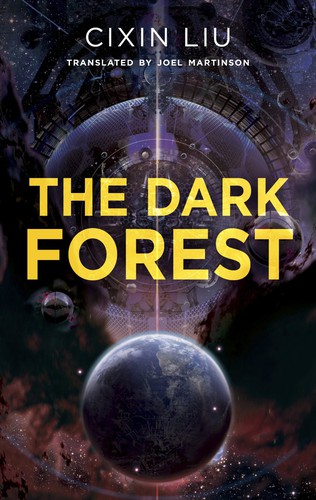
by Liu Cixin
Weakness and ignorance are not barriers to survival, but arrogance is.
During the Cultural Revolution, a young astrophysicist watches her father beaten to death for teaching relativity, then makes a choice that will decide the fate of the human species.
A secret military project makes first contact with an alien civilization from a chaotic three-sun system on the brink of collapse. As a countdown begins for humanity, the novel asks what a species does when it learns, with mathematical certainty, that a superior force is on its way. It is hard science fiction that treats physics, game theory, and history as engines of dread.
Liu Cixin serialized the novel in China's Science Fiction World in 2006, and it was published as a book in 2008. Ken Liu's English translation appeared in 2014, and in 2015 it became the first translated novel to win the Hugo Award for Best Novel, drawing praise from readers including Barack Obama.
The trilogy's seed is here: a universe where every civilization stays silent because being seen is being destroyed.
Watch dread built from real problems, like the unsolvable orbital motion of three gravitational bodies.
Humanity's first answer to the stars is decided by one woman's disillusionment with human cruelty.
A world of unpredictable suns produces a civilization desperate enough to cross the light-years for Earth.
The immersive VR game 'Three Body,' where players rebuild a civilization only to watch it burn or freeze each time the three suns misalign, including a computer built from millions of human soldiers.
Ye Wenjie at the Red Coast Base receiving an alien warning not to reply, and choosing to answer anyway, inviting the fleet toward Earth.
The scale is staggering. The first sci-fi in years that made me feel genuinely small.