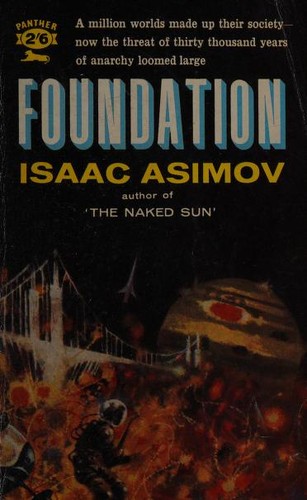
Foundation
by Isaac Asimov
Violence is the last refuge of the incompetent.
Why read it
A mathematician predicts that the Galactic Empire will collapse into thirty thousand years of barbarism, and he has a plan to shorten the dark age to a single millennium. The Empire, of course, exiles him for treason.
Hari Seldon's science of 'psychohistory' can forecast the behavior of billions across centuries, so he establishes a Foundation at the galaxy's edge to preserve knowledge and rebuild civilization. Across generations, the Foundation faces a series of predicted crises, each resolved not by force but by the inexorable logic of history. It is a sweeping saga about whether the future can be engineered.
Isaac Asimov built Foundation from a series of stories published in Astounding Science Fiction between 1942 and 1950, inspired by Gibbon's The History of the Decline and Fall of the Roman Empire. The trilogy was later honored with a one-time Hugo Award for 'Best All-Time Series' in 1966, beating out Tolkien's The Lord of the Rings.
- 01
History as a science
Psychohistory frames the notion that crowds are predictable even when individuals are not, a provocative lens on society and statistics.
- 02
Crisis by design
Each 'Seldon Crisis' teaches that the right constraints can force a good outcome, no hero required.
- 03
Knowledge as power
The Foundation survives by controlling science and technology, showing how expertise becomes leverage over stronger neighbors.
- 04
The long view
What awaits is a story told across centuries, where no single character matters as much as the arc of civilization itself.
Salvor Hardin defusing the Anacreon threat by playing four rival kingdoms against one another, proving that violence is the last refuge of the incompetent.
Hari Seldon's recorded image appearing in the Time Vault to reveal, generations after his death, that each crisis was foreseen.