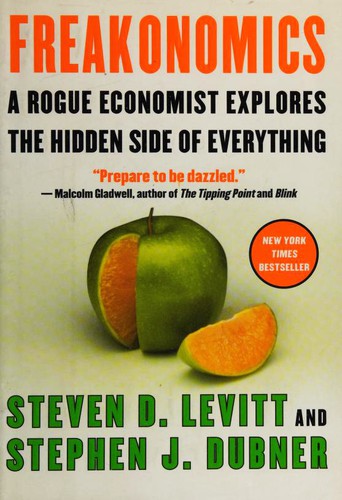
Freakonomics
Morality, it could be argued, represents the way that people would like the world to work — whereas economics represents how it actually does work.
Why read it
Which is more dangerous: the neighbor's house with a gun, or the one with a swimming pool? (The pool, by a mile.) An economist who asks strange questions and a journalist who can write teamed up to X-ray everyday life through incentives — and accidentally invented a genre, a podcast empire, and twenty years of dinner-party arguments.
Economics, stripped of its GDP costume, is just the study of incentives — how people get what they want, and how they cheat when the scoreboard is watched. Levitt's method: find data nobody thought to torture (sumo tournament records, crack gang ledgers, baby-name registries), ask what people are actually rewarded for, and follow the numbers past the conventional wisdom. Morality describes how we'd like the world to work; economics describes how it does.
Levitt won the 2003 John Bates Clark Medal (economics' under-40 prize) for exactly this kind of off-road empirical work; Dubner profiled him for the New York Times, and the odd-couple collaboration (2005) sold over 4 million copies. The abortion-and-crime chapter ignited a controversy that never fully banked; the franchise — sequels, film, and one of the longest-running podcasts on earth — turned 'freakonomics' into a common noun for the genre it created.
- 01
Cheating leaves fingerprints in data
Chicago teachers erasing wrong answers and sumo wrestlers gifting must-win bouts get caught the same way: their numbers deviate exactly where incentives say they should. Fraud detection as statistics.
- 02
Information asymmetry is power
Real-estate agents keep their own homes on the market ten days longer than yours; the Klan's power collapsed when its secrets were broadcast on the Superman radio show. Experts profit from what you don't know — until the data leaks.
- 03
Conventional wisdom has an author
From crack gangs living with their mothers ($3.30/hour foot soldiers) to the invented statistics of advocacy, the book keeps asking who benefits from the story you've been told.
- 04
Correlation vs. causation, weaponized
The parenting chapters — what parents ARE (books in the home) versus what they DO (reading to kids nightly) — are a masterclass in why most 'obvious' causes are selection effects wearing costumes.
Sudhir Venkatesh walks into a Chicago project with a clipboard survey and walks out, years later, with a crack gang's complete financial books — revealing a franchise structure identical to McDonald's, where the median dealer earns less than minimum wage and lives with his mom.
The Israeli daycare that fined late parents — and lateness DOUBLED: the fine converted a moral obligation into a cheap price. The book's most retold example of incentives backfiring, ten pages in.