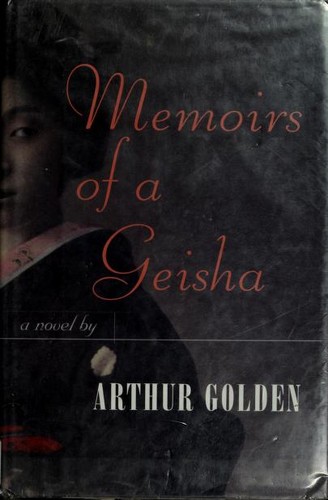
Memoirs of a Geisha
We lead our lives like water flowing down a hill, going more or less in one direction until we splash into something that forces us to find a new course.
Why read it
A nine-year-old with strange gray eyes is sold from a fishing village to a Kyoto okiya, renamed Sayuri, and schooled in an art whose whole purpose is to be unforgettable — while owning nothing, not even her own future. Golden's novel poured a vanished world through one woman's voice and parked on the bestseller lists for two years.
Framed as the taped recollections of a retired geisha in New York, the novel reconstructs Gion's floating world — the tea houses, the danna system, the art and the accounting — through Sayuri's rise from scullery maid to celebrated geisha, powered by rivalry with the magnificent, vicious Hatsumomo and mentorship by the pragmatic Mameha. Its through-line is a single fixed star: the Chairman, a moment of kindness on a bridge that Sayuri converts into a life's navigation. The book is honest about the ledger underneath the silk — beauty as an economy in which the asset is the self.
Golden, a Harvard-and-Columbia-trained Japanologist, rewrote the novel three times over ten years, switching to first person after interviewing retired geisha Mineko Iwasaki — who later sued over being named in the acknowledgments (settled out of court) and published her own corrective memoir, Geisha of Gion. Published 1997: 58 weeks on the NYT list, four million copies, and the 2005 film; the authenticity controversy remains an instructive companion text.
- 01
The floating world's economics
Debts logged from the first day, a virginity auction, the danna system — Golden keeps the arithmetic visible beneath the artistry, which is the novel's real subject.
- 02
Hatsumomo
The okiya's reigning beauty, sabotaging Sayuri with rumor and fire — a rivalry plot that doubles as a study of what the system does to women who age inside it.
- 03
Water in the personality
Sayuri's self-mythology — adaptable, persistent, finding the crack in every stone — the novel's metaphor system for agency exercised inside constraint.
- 04
The Chairman's handkerchief
One kindness converted into a decades-long strategy: the romance reads as devotion or as the only ownable dream in an unownable life — the book supports both readings.
The bridge scene: weeping child Chiyo, a stranger's gentle words and a coin for shaved ice — and her decision, on the spot, to become someone such a man might someday see. The novel's entire engine installed in two pages.
Sayuri's mizuage auction, narrated with the same composed voice as the tea ceremonies — the book's most debated passage, where the artistry and the commerce refuse to stay separate.