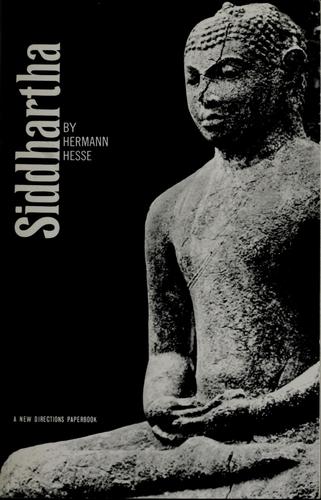
Siddhartha
Wisdom cannot be imparted. Wisdom that a wise man attempts to impart always sounds like foolishness.
Why read it
A brilliant Brahmin's son walks out on his caste, joins the ascetics, meets the actual Buddha — and walks away from him too, convinced that no teacher can hand you what a river can. Hesse's slim novel became the West's favorite door into Eastern thought, and the graduation gift that keeps rearranging lives.
Siddhartha's insight when he meets Gotama is the book's radical move: the Buddha's doctrine is flawless, and doctrine is precisely what can't be transmitted — 'wisdom cannot be imparted.' So he apprentices himself to everything else: to the courtesan Kamala (desire), the merchant Kamaswami (commerce), despair itself at the riverbank, and finally to the ferryman Vasudeva and the river, whose all-at-once voice dissolves time. Each life must be drunk to the bottom; the detours aren't the failure of the path — they are the path.
Hesse — son and grandson of missionaries to India, in Jungian analysis after a shattering midlife crisis — wrote it in 1922, stalling for over a year before Part Two because he refused to write realization he hadn't touched. The 1951 American edition detonated with the Beats and then the sixties counterculture; the Nobel committee (1946) had already cited his 'classic ideals of humanity.' It remains among the most-assigned short novels on earth.
- 01
Wisdom can't be taught
The meeting with the Buddha — reverent, admiring, and departing — is the book's thesis scene: teachings communicate knowledge, never the experience that made them true.
- 02
The sensual detour
Kamala and the counting-house aren't a fall from the path; Hesse insists the seeker must go THROUGH appetite and disgust, not around them — the chapter most readers underline at forty.
- 03
The river's teaching
All water returning, all moments simultaneous, the word Om under every voice — time as illusion, delivered by geography instead of lecture.
- 04
The son's rebellion
Siddhartha's own boy scorns and abandons him exactly as he abandoned his father — the wound that finally burns out his last superiority and completes the circle.
Govinda, Siddhartha's oldest friend, takes refuge in the Buddha's order while Siddhartha walks on alone — the fork between following and seeking, drawn in two farewells at the grove of Jetavana.
At the end, Govinda kisses his old friend's forehead and sees ten thousand faces — fish, criminals, gods, newborns — streaming through one smiling face: the book's vision of unity, given to the follower at last through the seeker.