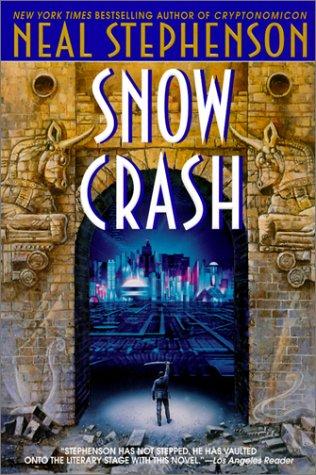
Snow Crash
Until a man is twenty-five, he still thinks, every so often, that under the right circumstances he could be the baddest man in the world.
Why read it
A pizza-delivering, sword-fighting hacker named Hiro Protagonist stumbles onto a new drug that crashes both computers and human minds. The trail leads from a fractured, privatized America into an ancient Sumerian conspiracy running on the deep code of the brain.
Snow Crash imagines a near-future of corporate city-states and a virtual Metaverse, where a mysterious force threatens to reprogram people like software. Neal Stephenson fuses cyberpunk action, linguistics, ancient myth, and satire into a wildly inventive thriller of ideas. It is a breakneck ride that also asks how language shapes and controls the mind.
Neal Stephenson published Snow Crash in 1992, and it became a defining novel of the cyberpunk genre. It popularized the term Metaverse and the concept of the avatar as a virtual self, influencing decades of technologists. The book began as an idea for a computer game before evolving into a novel.
- 01
Language as code
The premise that a deep neurolinguistic virus can hack the human brain drives its central mystery.
- 02
The Metaverse imagined
Stephenson's virtual world anticipated much of how we now think about digital life and avatars.
- 03
Corporate anarchy
A satirical future of privatized everything skewers libertarian fantasy and government collapse.
- 04
Myth as information
Ancient Sumerian religion is reimagined as an early form of software for the human mind.
The opening high-stakes pizza delivery, a virtuoso action set piece establishing the Deliverator and the novel's manic satirical energy.
Hiro's conversations with the Librarian daemon in the Metaverse, unpacking Sumerian myth as a theory of the brain as a programmable machine.