


Theo Bennett★ Reader · Lv 2
1 day agoArgued with every page and finished a different person. The dialogue format works.
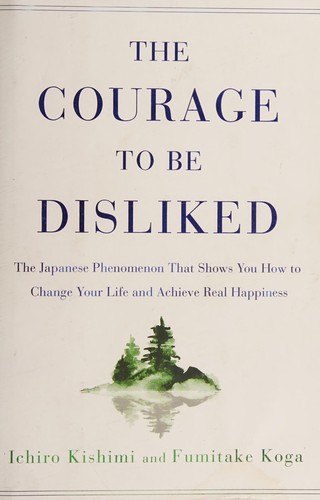
Freedom is being disliked by other people.
A resentful young man visits a philosopher who claims the world is simple and people can change tonight — and spends five long nights trying to prove him wrong. The Socratic cage match that sold four million copies across Asia argues something scandalous: your past doesn't determine anything, and your unhappiness is a choice you keep making because it works.
Kishimi and Koga deliver Alfred Adler — psychology's forgotten third giant, after Freud and Jung — as dialogue: trauma doesn't cause your present (teleology vs. etiology — you use the past to justify today's goals); all problems are interpersonal-relationship problems; and freedom is having the courage to be disliked, because needing approval makes you live everyone's life but yours. The tools: separation of tasks (whose problem is this actually?), horizontal relationships (encourage, never praise — praise is judgment from above), and community feeling as the destination.
Kishimi, a Japanese philosopher who spent decades translating Adler alongside Plato, teamed with writer Fumitake Koga — a former skeptic whose own conversion became the youth's role — to stage Adler in classical dialogue form. Published in Japan 2013: 3.5+ million copies there and in Korea, a phenomenon among young workers in hierarchical workplaces; the 2018 English edition rode word-of-mouth to global bestsellerdom without a marketing push.
The reversal that powers the book: you don't stay home because of anxiety; you generate anxiety in order to stay home. Purposes, not causes — outrageous, then increasingly hard to unsee.
Whose task is it? Your work is yours; their opinion of you is theirs. The cleanest boundary technology in the genre, and the chapter readers photograph.
Superiority and inferiority complexes are both escapes from being ordinary-and-improving; the book's quiet dagger for high-achievers.
Praise, like scolding, is judgment from above — Adler's case for encouragement between equals rewires how you talk to kids and teams by Tuesday.
The philosopher's opening gambit: a friend who 'wants to change' but can't leave his room is achieving his goal — the safety of never being judged — and the youth's outrage across the next fifty pages is the reader's own, staged and answered.
The red-face fear: a student who blushes claims it prevents her confessing to a boy — the philosopher argues she manufactures it to avoid the risk of rejection. Cruel, precise, and the book's method in miniature.
Argued with every page and finished a different person. The dialogue format works.