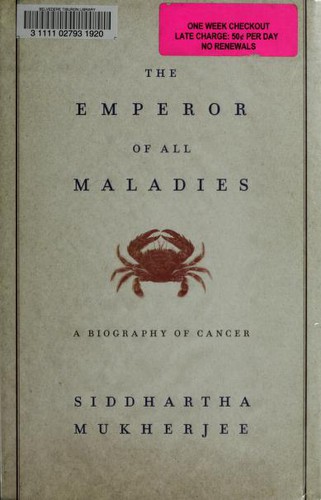
The Emperor of All Maladies
The story of leukemia -- the story of cancer -- isn't the story of doctors who struggle and survive. It is the story of patients who struggle and survive.
Why read it
An oncologist sets out to write a short account of the disease he treats every day, and ends up telling the four-thousand-year story of humanity's oldest and most feared enemy. Cancer, it turns out, has a biography, and it is inseparable from our own.
Mukherjee traces cancer from ancient Egyptian records through radical surgery, chemotherapy, and the molecular revolution, weaving science, history, and the lives of doctors and patients into one narrative. He shows both how far we have come and how the disease keeps outwitting us because it is, in a sense, a distorted version of ourselves. It is a Pulitzer-winning 'biography' of cancer.
Siddhartha Mukherjee, a physician and researcher, published The Emperor of All Maladies in 2010. It won the 2011 Pulitzer Prize for General Nonfiction, was named one of Time's 100 best nonfiction books, and was adapted into a Ken Burns-produced documentary. Mukherjee wrote it in part to answer his own patients' question: what exactly are we fighting?
- 01
Cancer as a moving target
You learn why a disease that is our own cells run amok is so uniquely hard to defeat.
- 02
Progress through failure
The history is a chain of blind alleys and partial wins, a realistic model of how science advances.
- 03
Patients at the center
Mukherjee insists the true heroism belongs to those who endure the illness, not only those who treat it.
- 04
Hope with clear eyes
The molecular era brings real breakthroughs without pretending a final cure is at hand.
Sidney Farber's 1948 use of antifolate drugs to induce the first temporary remissions in children with leukemia, launching modern chemotherapy.
The rise and slow fall of Halsted's radical mastectomy, a brutal surgery sustained for decades by the flawed belief that cutting more meant curing more.