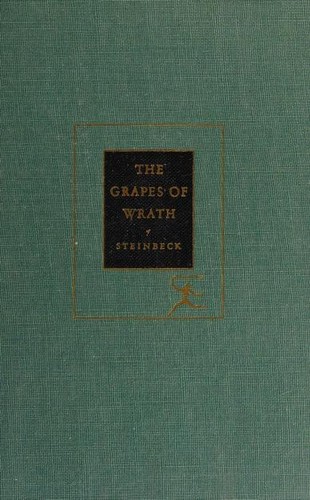
The Grapes of Wrath
Wherever they's a fight so hungry people can eat, I'll be there.
Why read it
The bank takes the farm, the handbills promise work in California, and the Joad family loads three generations onto a dying truck and points it west on Route 66. What they find at the end of the road made the novel a national scandal — burned in the counties it described, and awarded the Pulitzer the same year.
Steinbeck alternates the Joads' journey with 'interchapters' — the voice of the whole migration: the used-car sharks, the roadside camps, the one land turtle crossing the highway. The family's arc is dispossession discovering solidarity: Ma Joad holding the unit together as it sheds members, Tom moving from parolee minding his own business to organizer who can't anymore, and Preacher Casy converting from lost faith to labor gospel. The ending — a starving stranger, a young mother, a barn — remains the most argued final page in American fiction.
Steinbeck toured the California migrant camps as a journalist in 1936 and wrote the novel in a hundred-day fury, telling his agent he wanted to 'put a tag of shame on the greedy bastards' responsible. Published 1939: banned and burned in Kern County, denounced in Congress, defended by Eleanor Roosevelt, Pulitzer 1940 — and the spine of his 1962 Nobel.
- 01
The interchapters
Every other chapter widens to the collective — the corporations 'that breathe profits,' the highway itself. Steinbeck's structure argues the Joads are one wave of a flood, and the flood is the story.
- 02
Ma Joad's arithmetic
The novel's real protagonist: measuring food, morale, and the family's survivable losses. 'We're the people that live' is her thesis against the banks' math.
- 03
From I to we
Casy's gospel and Tom's education converge on the book's most quoted speech — 'I'll be ever'where' — the moment private grievance becomes movement.
- 04
The California lie
Handbills printed by growers to flood the labor market: the book dissects wage collapse by oversupply so clearly it doubles as an economics lecture with a body count.
The interchapter where owners bulldoze tenant houses: the driver is a neighbor's son, feeding his own family, and the tenant can't find anyone to shoot — 'Who can we shoot?' The novel's whole analysis of systemic blame in two pages.
Rose of Sharon, her baby stillborn, nursing a starving man in a rain-flooded barn — the final image Steinbeck refused to soften, cut, or explain, and defended to his editor as the entire point.