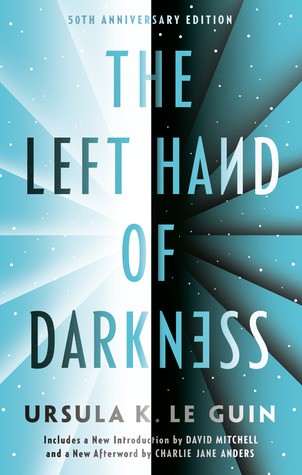
The Left Hand of Darkness
Light is the left hand of darkness and darkness the right hand of light.
Why read it
An envoy from a galactic coalition arrives alone on a frozen planet to invite its nations to join, and finds a people who are neither men nor women but both, and neither. His mission depends on understanding a species whose very biology overturns everything he assumes about power, trust, and desire.
On the ice world of Gethen, humans are ambisexual, taking on sex only once a month, so a society exists without fixed gender, without war as we know it, without the divisions Genly Ai takes for granted. As he navigates the politics of two rival nations, his fate becomes bound to an exiled statesman on an impossible journey across the ice. It is a landmark thought experiment about gender, difference, and loyalty.
Ursula K. Le Guin published The Left Hand of Darkness in 1969 as part of her Hainish cycle. It won both the Hugo and Nebula Awards and is widely regarded as a founding work of feminist science fiction, credited with expanding what the genre could say about sex and society.
- 01
Gender as invention
By imagining a world without permanent sex, Le Guin exposes how much of what we call 'natural' about men and women is cultural scaffolding.
- 02
The outsider's blindness
Genly's misreadings of Gethen show how our assumptions can make us fail the very people we most need to understand.
- 03
Loyalty and love
What awaits is one of SF's great friendships, forged in extremity, that redefines both characters.
- 04
Duality and balance
Light and dark, self and other, patience and action; the novel weaves a Taoist sense that opposites define each other.
Genly Ai and the exiled Estraven hauling a sledge on an eighty-day trek across the deadly Gobrin Ice, kept alive only by each other.
The quietly shattering moment when Genly must accept that a Gethen king he has been negotiating with is pregnant.