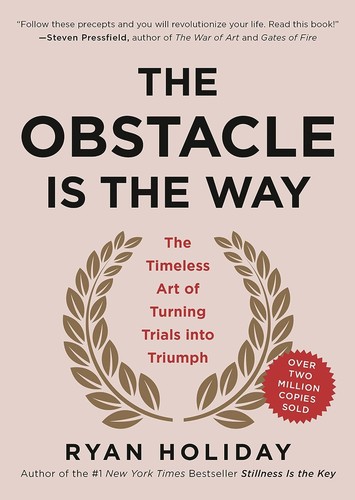
The Obstacle Is the Way
by Ryan Holiday
The impediment to action advances action. What stands in the way becomes the way.
Why read it
Marcus Aurelius wrote it in his war camp: the impediment to action advances action; what stands in the way becomes the way. Holiday took the emperor's sentence, loaded it with case studies from Rockefeller to Rommel's opponents, and produced the playbook NFL locker rooms and startup founders pass around like contraband.
Stoicism stripped for operators, in three disciplines: Perception (see events as neither good nor bad — just raw material; steady your nerve, seize the objective view), Action (directed energy, persistence, iteration — practice the process, do your job, use setbacks as fuel), and Will (the inner citadel for what you cannot change — amor fati, premeditatio malorum, something bigger than yourself). Each principle arrives strapped to a story: Edison watching his factory burn, Lincoln's melancholy as equipment, John D. Rockefeller finding calm inside panics.
Holiday dropped out of college at 19 to apprentice under Robert Greene, ran marketing at American Apparel through its chaos, and wrote this at 26 (2014) from the Stoic notecards he'd kept for years. It sold slowly, then found the diffusion network publishers dream about: the Patriots and Seahawks locker rooms, Special Forces reading lists, coaches buying cases. A million-plus copies, no ad campaign — and the launchpad for The Daily Stoic empire.
- 01
The discipline of perception
Rockefeller in the Panic of 1857, taking notes while others fled — events are objective, advantage goes to the one who refuses the panic's framing.
- 02
The energy of action
Persistence as iteration, not stubbornness: Edison's 'ten thousand ways that won't work,' Grant's steady hammering — the chapter set that turns philosophy into workload.
- 03
Amor fati
Not accepting fate — loving it: the fire that Edison watched consume his life's work at 67 ('we'll rebuild by morning') as the will's graduation exam.
- 04
Turning the trial into the training
The book's throughline: every obstacle is a rep — perception trains judgment, action trains creativity, will trains endurance. The gym is the setback itself.
Edison, watching his New Jersey plant burn beyond saving, tells his son: 'Go get your mother and all her friends — they'll never see a fire like this again.' Three weeks later the factory partially reopens; the anecdote leads the Will section for a reason.
Demosthenes — sickly, stammering, cheated of his inheritance — building himself into Athens' greatest orator with pebbles in his mouth and speeches against the sea: Holiday's proof that the deficiency itself supplied the method.