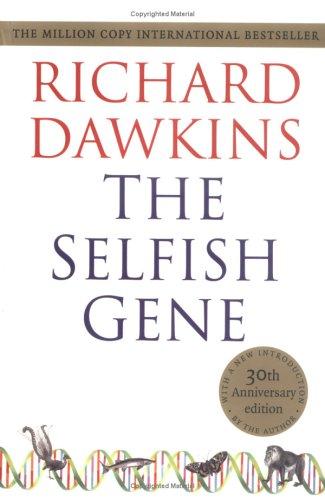
The Selfish Gene
We are survival machines—robot vehicles blindly programmed to preserve the selfish molecules known as genes.
Why read it
We tend to think evolution works for the good of the species, or the individual. Dawkins flips the lens: the real unit of natural selection is the gene, and we, bodies, brains, and all, are elaborate survival machines it builds to copy itself.
Dawkins argues that genes that promote their own replication persist, and that this 'gene's-eye view' elegantly explains behaviors that seem altruistic, from a bee's suicidal sting to a mother's sacrifice. Crucially, 'selfish' describes the gene, not the organism: cooperation and even kindness can be the strategies selfish genes favor. Along the way he coins the 'meme' to extend the same logic to culture.
Published in 1976, it was the young Oxford zoologist Richard Dawkins's first book, synthesizing ideas from W.D. Hamilton, George Williams, and Robert Trivers into a single vivid frame. It became a landmark of popular science, introduced the word 'meme' into the language, and remains one of the most influential and debated science books of the twentieth century.
- 01
The gene's-eye view
Shifting the unit of selection from organism to gene reframes evolution and dissolves many old puzzles.
- 02
Kin selection
Genes for helping relatives spread because relatives carry copies of the same genes, explaining family altruism.
- 03
Survival machines
Bodies are vehicles genes build and discard, a startling inversion of how we usually see ourselves.
- 04
Memes
Dawkins extends replicator logic to culture: ideas, tunes, and beliefs that copy themselves through minds.
The analysis of why a bird might give an alarm call, seemingly risking itself, dissolves into clean gene-level math about shared copies in kin.
The chapter introducing memes, likening a catchy tune or belief spreading through brains to a gene spreading through bodies, launched an entire vocabulary.