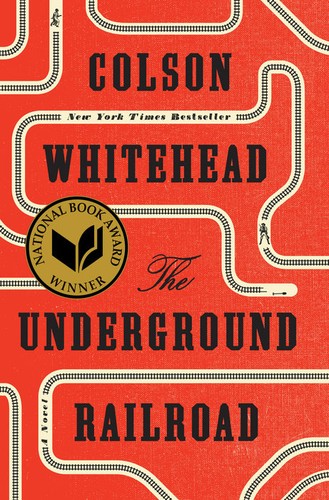
The Underground Railroad
If you want to see what this nation is all about, I always say, you have to ride the rails. Look outside as you speed through, and you'll find the true face of America.
Why read it
On a brutal Georgia cotton plantation, a young enslaved woman named Cora agrees to run. But in this telling, the Underground Railroad is no metaphor: it is a literal network of tracks and locomotives tunneled beneath the soil of the South.
As Cora flees north, each state she passes through becomes a different, chillingly reimagined version of America's racial nightmare, from false benevolence to open genocide, while a relentless slave catcher hunts her. By making the railroad real, the novel turns the flight to freedom into a searing tour of the many faces of American racism. It is history reimagined as fable.
Colson Whitehead published The Underground Railroad in 2016. It won both the Pulitzer Prize for Fiction and the National Book Award, was an Oprah's Book Club selection, and was adapted into a series by director Barry Jenkins. Whitehead had carried the central idea, a literal railroad, for more than a decade before writing it.
- 01
The literal railroad
Turning a metaphor into iron and steam gives the escape mythic weight and estranges a familiar history.
- 02
America state by state
Each stop is a distinct experiment in oppression, mapping the varied machinery of white supremacy.
- 03
The unrelenting hunter
What awaits is the dread of the slave catcher Ridgeway, whose pursuit embodies the reach of the system.
- 04
Freedom as a moving target
Cora learns that crossing a border rarely means safety, only a new shape of danger.
Cora being led down through a trapdoor beneath a Georgia farmhouse to a real subterranean station with a platform, rails, and a waiting boxcar.
The horror of North Carolina's 'Freedom Trail,' a road lined for miles with the hanged bodies of Black people.