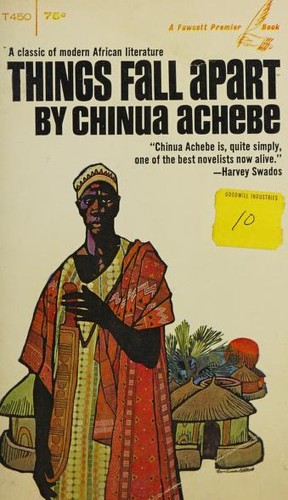
Things Fall Apart
The white man is very clever. He has put a knife on the things that held us together and we have fallen apart.
Why read it
Okonkwo has spent his life outrunning his father's laziness — wrestling champion, wealthy farmer, feared warrior in the nine villages. Then the white missionaries arrive with a new god, a new government, and a new story in which he is the savage. The most-read African novel ever written is colonialism narrated, finally, from the other side.
Achebe spends half the novel building Umuofia in full — its courts, proverbs, harvest rites, its cruelties too — so that when the British arrive, you feel a civilization interrupted rather than discovered. Okonkwo, rigid where his culture is supple, breaks against the change; his tragedy is doubled because his flaws are his own and the catastrophe is not. The final page, shifting into the District Commissioner's voice, is the coldest indictment in modern literature.
Achebe wrote it at 28, a Nigerian broadcaster answering the Africa of Heart of Darkness and Mister Johnson — books where his people were scenery. He sent his only handwritten manuscript to a London typing service that nearly lost it. Published in 1958, two years before Nigerian independence, it has sold over 20 million copies in 57 languages and begins the 'African Trilogy' completed by No Longer at Ease and Arrow of God.
- 01
Umuofia before
Bride-price negotiations, the egwugwu court, the Week of Peace — Achebe documents a working legal and religious order so the 'civilizing mission' arrives visibly redundant.
- 02
Okonkwo's flaw
Not rage but fear — of resembling his gentle, indebted father. His harshness toward his son and his part in Ikemefuna's death are self-inflicted wounds the colonizers merely finish.
- 03
How conquest actually works
The missionaries take the outcasts first, then the questioning sons; the courts follow the converts; the gun comes last. A machine described so precisely it reads as method.
- 04
The final paragraph
The District Commissioner, planning his book, allots Okonkwo's whole life 'a reasonable paragraph' — Achebe hands the colonizer the last word and lets it convict itself.
Ikemefuna, the hostage boy who calls Okonkwo father, walks to his death reassured — and Okonkwo, warned by the elders to stay home, strikes the final blow 'afraid of being thought weak.' The novel's moral wound, self-dealt.
Okonkwo's friend Obierika, the book's questioning conscience, sits afterward wondering why a man should suffer for an offense he committed unknowingly — Igbo philosophy interrogating itself, no missionary required.