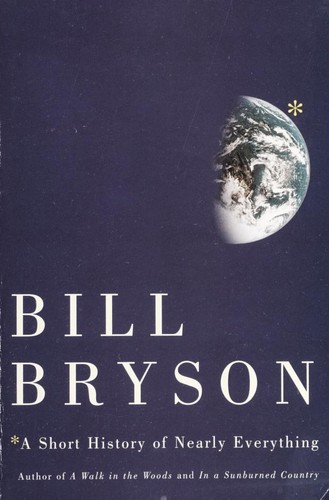
A Short History of Nearly Everything
by Bill Bryson
If this book has a lesson, it is that we are awfully lucky to be here.
Why read it
Bryson realized mid-flight that he didn't know why the ocean is salty, how anyone weighed the Earth, or what actually happens when scientists say 'the universe began' — so he spent three years asking them. The result outsold every science book of its decade: all of existence, explained by the funniest tour guide who ever did the reading.
It's a history of what we know AND how we came to know it — with the knowers restored to full, ridiculous humanity: Newton sticking a needle in his own eye socket, the Reverend Evans finding supernovae from his porch, Marie Curie's still-radioactive cookbooks. Bryson's twin theses: existence is preposterously improbable (yours especially), and knowledge was won by obsessives who were frequently wrong first. The scale runs from atoms to supervolcanoes to the Big Bang — calibrated to produce awe on roughly every third page.
Bryson — the Iowa-born travel writer who'd conquered the Appalachian Trail and Britain by complaint — put travel aside for three years of reading and interviews, admitting total amateur status as the method: every explanation had to survive his own incomprehension first. Published 2003: the UK's best-selling nonfiction book of the decade, the Aventis Prize, and a permanent place on 'books that made me love science' lists.
- 01
The improbability of you
The opening meditation — trillions of atoms assembling, briefly, into a thing that can read about atoms — sets the book's register: gratitude disguised as comedy.
- 02
Science is people
The Yorkshire parson measuring mountains, Cavendish too shy to publish, fossil wars fought with dynamite — discovery as biography, which is why it sticks.
- 03
How we nearly missed everything
Wrong ages of the Earth, dismissed continental drift, the ozone hole found by accident — Bryson keeps the errors in, teaching how knowledge actually advances: embarrassingly.
- 04
The precarious present
Yellowstone's caldera, asteroid odds, bacteria that outvote us — the closing chapters' quiet argument: the same fragility that makes us lucky makes us temporary.
The Reverend Robert Evans, amateur astronomer, whose party trick is noticing one changed dot among thousands of galaxies — Bryson's emblem of science: patience, porch, and a preposterous gift used nightly.
Marie Curie's notebooks, still too radioactive to handle, stored in lead-lined boxes — and researchers signing waivers to read them: the price of discovery, filed under 'things Bryson tells you at exactly the right moment.'