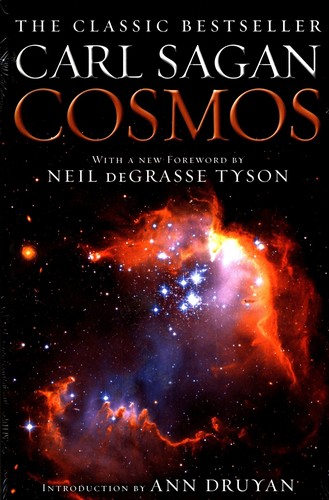
Cosmos
by Carl Sagan
The cosmos is within us. We are made of star-stuff.
Why read it
Sagan invites you to stand on Earth as a 'pale blue dot' and take the grandest tour imaginable, from the workings of a single cell to the birth of galaxies, all narrated by a scientist who could make the whole universe feel like a story being told just to you.
Cosmos is a sweeping account of how humans came to understand their place in the universe, weaving astronomy, biology, and history into one narrative. Its deeper argument is a case for the scientific way of thinking, curiosity, skepticism, and wonder, as both humanity's greatest tool and its best hope, set against the backdrop of a cosmos vast beyond intuition and yet knowable.
Published in 1980 as the companion to Carl Sagan's landmark PBS television series of the same name, which was watched by hundreds of millions worldwide. Sagan, a Cornell astronomer who helped design the Voyager probes' Golden Record, wrote it to bring the excitement of science to a mass audience. It became one of the best-selling science books ever published in English.
- 01
The cosmic calendar
Compressing all of cosmic history into a single year makes humanity's brief, late arrival viscerally clear.
- 02
We are star stuff
The elements in our bodies were forged in stars, linking human life directly to cosmic history.
- 03
The library of Alexandria
Sagan uses its loss to mourn what humanity forfeits when curiosity is suppressed.
- 04
Science as a candle
The book champions skeptical inquiry as the reliable path from superstition to understanding.
Sagan's retelling of Eratosthenes measuring the circumference of the Earth around 200 BCE, using only shadows and geometry, shows science's power in a single elegant story.
The meditation on the destruction of the ancient Library of Alexandria and the murder of the scholar Hypatia is a moving lament for lost knowledge.