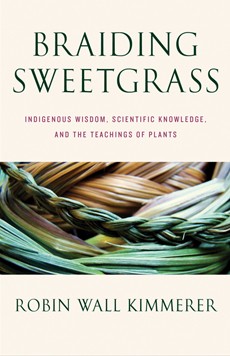
Braiding Sweetgrass
All flourishing is mutual.
Why read it
A botanist who is also a member of the Potawatomi Nation asks what science misses when it forgets that plants might have something to teach us. Her answer braids laboratory knowledge with Indigenous wisdom into a new way of seeing the living world.
Kimmerer weaves together scientific insight, Native American teachings, and personal essay to argue for a reciprocal relationship with nature, one of gratitude and giving back rather than extraction. The book proposes that Indigenous knowledge and Western science, joined, can heal our broken bond with the earth.
Robin Wall Kimmerer, a botanist and professor, published Braiding Sweetgrass in 2013 with the small press Milkweed Editions. Through years of word-of-mouth it became a long-running New York Times bestseller and one of the most beloved works of contemporary nature writing.
- 01
The grammar of animacy
You gain a new way of speaking about nature, where a plant is a who rather than an it, and language reshapes relationship.
- 02
Reciprocity over extraction
Kimmerer's central teaching is the Honorable Harvest: take only what you need and give back in return.
- 03
Two ways of knowing
The book shows how Indigenous wisdom and empirical science can enrich rather than contradict each other.
- 04
Gratitude as practice
A recurring takeaway is that gratitude, formalized in ritual and attention, changes how we treat the world.
The parable of the Three Sisters, corn, beans, and squash, whose interdependence models a cooperative rather than competitive nature.
Kimmerer's account of the Onondaga Nation's Thanksgiving Address, a daily recitation of gratitude to the natural world.