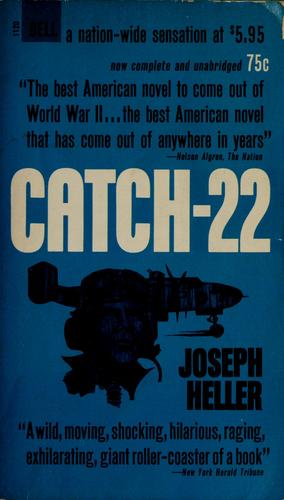
Catch-22
He was going to live forever, or die in the attempt.
Why read it
Bombardier Yossarian has one goal — stop flying missions before they kill him — and one obstacle: the rule that says wanting out of combat proves you're sane enough to stay in it. Heller's war novel named the trap, and seventy years later everyone still lives in some version of it.
On the island of Pianosa, the number of required missions keeps rising, the mess officer's syndicate bombs its own squadron for profit, and men are declared dead or alive according to paperwork rather than pulses. Heller builds the war not as tragedy but as a bureaucratic machine that converts logic into a weapon against the people inside it. The comedy loops and repeats — then, in the late chapters, the same scenes replay with the laughter stripped out, and you realize the jokes were load-bearing.
Heller flew 60 combat missions as a B-25 bombardier over Italy and spent eight years writing the novel around his advertising day job. Published in 1961 to mixed reviews, it caught fire with the generation heading to Vietnam; 'catch-22' entered the dictionary within a decade — the rare novel to add a phrase the language couldn't do without.
- 01
The catch itself
Orr is crazy if he flies, sane if he asks not to — and asking proves sanity. Chapter five's famous passage is the cleanest description of institutional no-win logic ever written.
- 02
Milo's syndicate
Mess officer Milo Minderbinder builds a trading empire where everyone 'has a share' — and contracts with both sides, eventually strafing his own base at cost-plus-six-percent. Capitalism satirized so precisely it reads as prophecy.
- 03
The chronology trap
The novel loops through time, returning to Snowden's death over Avignon in fragments — the structure is Yossarian's trauma, and the full scene, when it finally lands, recontextualizes every joke before it.
- 04
The dead man in the tent
Paperwork as ontology: a pilot killed before officially reporting can't be declared dead; Doc Daneeka, alive, is officially dead and can't be undeclared. Bureaucracy defeating reality itself.
Snowden's secret, revealed at last in the plane's freezing tail: 'Man was matter. The spirit gone, man is garbage.' The scene the whole carnival was built to survive telling.
Yossarian is offered the deal — go home a hero if he approves of the colonels who kept raising the missions — and refuses, choosing a paddle-boat-sized hope instead. The ending that made evasion a moral stance.