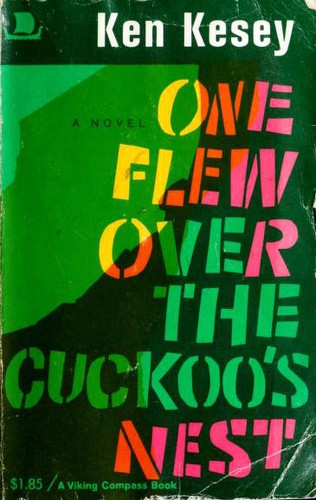
One Flew Over the Cuckoo's Nest
by Ken Kesey
But I tried, though. Goddammit, I sure as hell did that much, didn't I?
Why read it
A brawling, gambling con man gets himself committed to a psychiatric ward, figuring it beats a prison work farm, and collides with Nurse Ratched, whose soft-spoken tyranny runs the place like clockwork. What follows is a war for the souls of the men on the ward.
Narrated by a half-Native American patient who pretends to be deaf and mute, Kesey's novel pits the irrepressible McMurphy against the institution's machinery of control. It is a 1960s parable about conformity, sanity, and rebellion, asking who really gets to define madness, and at what cost the individual asserts himself against a system built to grind him down.
Published in 1962, the novel grew from Kesey's experiences working the night shift at a veterans' hospital psychiatric ward and volunteering for government drug experiments, some of the writing done under the influence of those substances. It became a countercultural touchstone and the 1975 film adaptation swept all five major Academy Awards.
- 01
The Combine
Chief Bromden's term for the vast social machine that processes people into conformity frames the whole novel's paranoia.
- 02
McMurphy vs. Ratched
The escalating duel between the life-force con man and the icily controlling nurse is the book's central struggle.
- 03
The fog
Bromden's hallucinated fog, which lifts as he grows braver, tracks his return from numbness to selfhood.
- 04
Laughter as resistance
McMurphy weaponizes humor and appetite against a ward that has forgotten how to feel either.
McMurphy bets he can lift a massive control panel to escape, fails, then turns to the ward and says at least he tried, a small mutiny that emboldens the others.
The unsanctioned fishing trip, where McMurphy takes the patients out to sea, briefly restores their dignity and laughter in one of the novel's most joyous sequences.