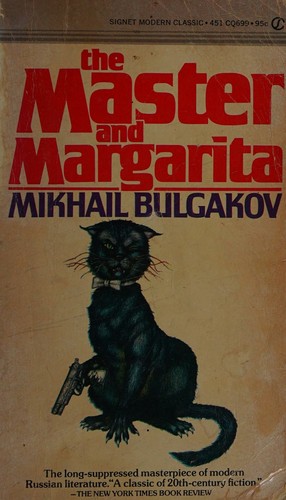
The Master and Margarita
Manuscripts don't burn.
Why read it
The Devil arrives in atheist 1930s Moscow with a talking black cat and a retinue of demons, and the city's smug literary elite have no idea what is about to hit them. Meanwhile, a persecuted writer and the woman who loves him wait for a miracle.
Bulgakov's masterpiece braids three stories, satanic mayhem in Soviet Moscow, a doomed love, and Pontius Pilate's judgment of Yeshua, into a wild satire of tyranny, cowardice, and artistic freedom. Written under Stalin and hidden for decades, it argues that art and love outlast any regime.
Mikhail Bulgakov wrote and rewrote the novel from 1928 until his death in 1940, burning an early draft in despair. It was published only in a censored form in 1966-67, decades later, and the full text became a sensation and an enduring symbol of artistic survival under Soviet rule.
- 01
Satire against tyranny
You watch the Devil expose the greed and cowardice of a society that has outlawed God, a coded assault on Stalinist life.
- 02
The novel within the novel
The Pilate chapters, the Master's forbidden book, mirror the frame story and deepen its meditation on courage and guilt.
- 03
Love as salvation
Margarita's willingness to bargain with the Devil for the Master's sake becomes the story's fierce moral center.
- 04
Art is indestructible
The famous claim that manuscripts don't burn stands as the book's defiant answer to every censor.
The chaotic black-magic show at the Variety Theatre, where Woland's demons shower the audience with money and vanishing fashions to humiliating effect.
Margarita's flight naked over Moscow and her role as hostess of Satan's midnight ball, hosting the risen dead.