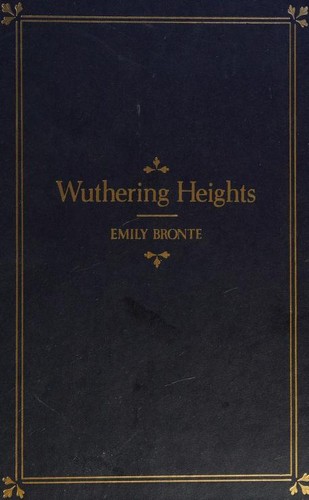
Wuthering Heights
by Emily Brontë
Whatever our souls are made of, his and mine are the same.
Why read it
A gentleman rents a house on the Yorkshire moors, visits his strange landlord, and spends a night hearing a dead woman scratch at the window. The housekeeper then tells him thirty years of the story — love so violent it ruins two families and declines to stop at death. Emily Brontë wrote one novel. It needed no sequel.
Heathcliff, a foundling brought to Wuthering Heights, and Cathy Earnshaw grow up wild and inseparable — 'whatever our souls are made of, his and mine are the same.' Her choice of civilized Edgar Linton over him detonates the book: Heathcliff leaves, returns rich, and executes a generation-spanning revenge that consumes both houses and their children. Brontë refuses every softening: this is passion as force of nature, amoral as the moor, and the novel's frame of sensible narrators only measures how far outside their categories it burns.
Emily Brontë published it in 1847 under the name 'Ellis Bell' and died a year later at 30, having reviewed exactly none of the scandalized notices calling it coarse and brutal. Her sister Charlotte's apologetic preface to the 1850 reissue — explaining Emily as an unworldly genius who didn't know what she'd made — began 170 years of readers deciding Charlotte was wrong: she knew exactly.
- 01
Two houses, one storm
Wuthering Heights (wild, exposed) and Thrushcross Grange (soft, civilized) structure the whole book — characters degrade or recover depending on which roof they're under.
- 02
The second generation
The book's underrated half: Heathcliff farming his revenge through Cathy's daughter, his own son, and Hareton — and the quiet counter-love that finally breaks the cycle.
- 03
'I am Heathcliff'
Cathy's declaration — not 'I love him' but identity itself — is the novel's thesis: a bond prior to morality, marriage, or even personality, which is why her marriage to Edgar reads as self-amputation.
- 04
The frame as measuring stick
Prim Lockwood and decent Nelly Dean narrate forces they can't comprehend — Brontë's device for letting the reader feel the story exceed its telling.
Lockwood's nightmare: the ghost-child Cathy gripping his hand through the broken window — 'let me in, let me in' — and his panicked cruelty, rubbing her wrist on the glass. The most shocking opening haunting in English fiction, and it's chapter three.
Heathcliff, learning of Cathy's death, dashes his head against a tree and howls 'not like a man, but like a savage beast' — then prays her ghost haunt him for the rest of his life. It obliges.